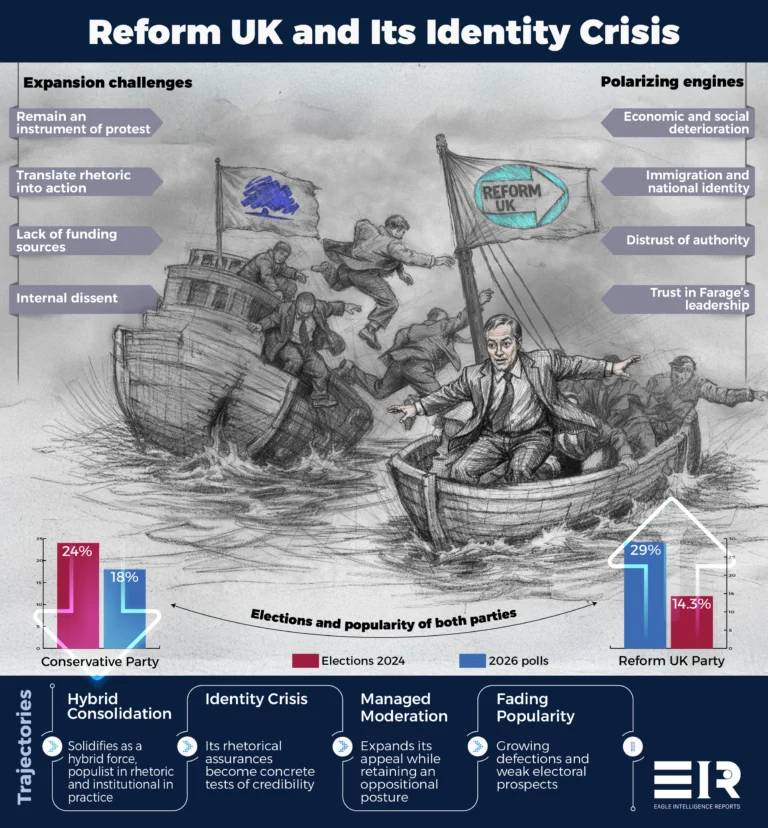



Nigel Farage’s Reform UK emerged as an insurgent challenge to Britain’s two-party order by mobilizing discontent with what it calls a broken political system. Yet its recent absorption of defectors from the Conservative Party exposes a central contradiction: a party defined by opposition to the establishment is increasingly staffed by figures drawn from it. Reform’s growth may expand its institutional reach, but it also risks blurring the outsider identity on which its appeal depends.
Tory Defections and the Outsider Claims
Reform, the UK’s far-right populist party led by Nigel Farage, has recently engineered and benefited from a series of high-profile defections from the Conservative Party. These include former chancellor Nadhim Zahawi, former home secretary Suella Braverman, and MPs such as Andrew Rosindell, Danny Kruger, and Robert Jenrick, who defected while sitting in the House of Commons. The scale of these movements is unusual in modern British politics.
Reform first entered Parliament in the 2024 general election with a small cohort of MPs largely new to Westminster, including Lee Anderson (who had previously left the Conservatives), Richard Tice, Nigel Farage, and a few others. It now has a parliamentary roster in which a majority of serving MPs trained their political muscles in the Conservative Party.
Reform UK now has a parliamentary roster in which a majority of serving MPs trained their political muscles in the Conservative Party
This proliferation of ex-Conservative MPs is a structural fact that could directly complicate Reform’s future aspirations. The party’s core message since its founding has emphasized breaking from “do-nothing” Westminster politics, rejecting technocratic inertia, and claiming to represent voters whom mainstream parties have ignored or betrayed.
Structural Roots of Populist Discontent
This posture, however, does not emerge in a vacuum. Reform’s appeal is amplified by underlying economic and social conditions that have sharpened public resentment toward the political class over the past decade. Stagnant real wages, rising housing costs, the erosion of stable employment in post-industrial regions, and the fiscal hollowing-out of local government have contributed to a sense that the political system is unresponsive to lived experience. Reform’s rhetoric gains traction not merely because it performs antagonism effectively, but because it attaches itself to grievances that predate the party itself.
Now, however, Reform could begin to look increasingly like a conduit for established politicians seeking new pathways to parliamentary relevance amid the Conservative Party’s own electoral decline, rather than a vessel for genuinely new political actors.
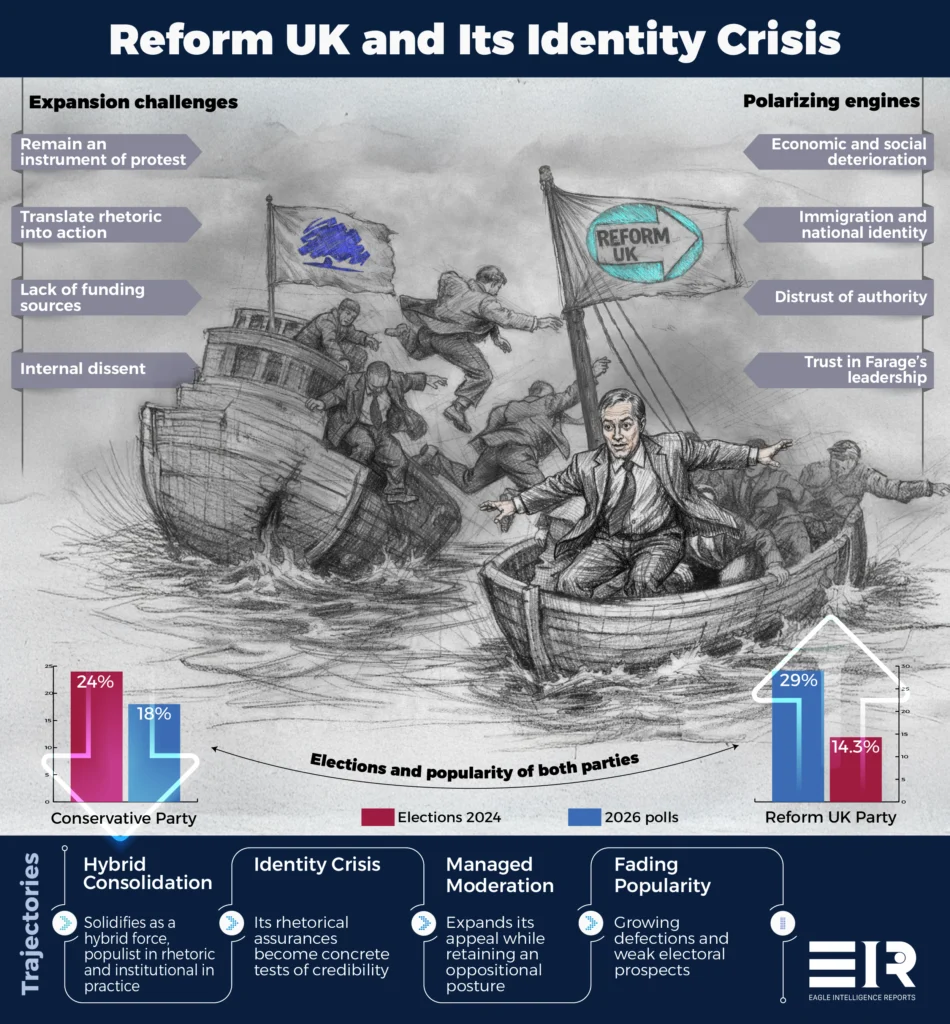
Since the Tories’ 2024 general election defeat, when it secured just 24 per cent of the vote, support has continued to slide, now standing at around 18 per cent. Under Kemi Badenoch, the party has sought to consolidate its base by moving further to the right, but current trends suggest that the next election could see a significant number of sitting Conservative MPs lose their seats. Reform, meanwhile, stands at 29 per cent—roughly 10 points ahead of the current Labour government. These numbers are important because they show that, far from being a marginal fringe, Reform is perceived by a significant portion of the British public as a credible political vehicle and, for many former and current Tory MPs, a de facto rescue raft off a sinking ship.
Defections, Branding, and Credibility
From a branding perspective, this matters because Reform’s political identity has rested on an outsider aura that is, by definition, at odds with incorporating mainstream Conservative figures who previously held ministerial office. Recognizing this does not reduce Reform’s rise to a purely economic revolt, nor does it suggest that material grievance automatically produces populist politics. Rather, insurgency functions here as a political language through which unresolved material and social anxieties are expressed. Symbolic antagonism substitutes for institutional responsiveness when voters believe that conventional channels of representation have ceased to function. Reform’s anti-establishment identity is therefore less a cultural preference than a political response to structural stagnation.
To mitigate adverse effects, the party’s leadership is trying to reassure supporters by insisting that former Conservative MPs will not necessarily become future candidates. For example, Zia Yusuf, Reform’s head of policy, publicly stated that “failed former Tory MPs” are unlikely to be selected as candidates at the next general election.
While the validity of this statement remains doubtful, Reform presents the influx of former Conservative MPs not as opportunism but as evidence of a shared commitment to systemic overhaul. It is framed as proof that even seasoned insiders recognize the dysfunction of Westminster and the inadequacy of traditional parties. By casting ex-Tories as converts to a movement aimed at changing the political status quo, Reform seeks to recast potential liabilities as strategic assets.
By casting ex-Tories as converts to a movement aimed at changing the political status quo, Reform seeks to recast potential liabilities as strategic assets
Yet, such assertions do not fully reconcile the symbolic incongruity created by high-profile defections that receive disproportionate media coverage in the UK. The current debate thus highlights a strategic inflection point for Reform: it must balance electoral ambition and organizational growth against the need to maintain a coherent identity that resonates with its base. Here, the risk is not only reputational; it also extends to policy coherence and governance credibility.
Governance Pressures and Institutional Limits
One clear example of the tension between ideological purity and pragmatic governance lies in Reform’s evolving policy positions. Its decision to reverse an earlier pledge to scrap the two-child benefit cap can be interpreted as either strategic flexibility or ideological ambiguity. More telling, however, is what the shift signals: Reform is aligning more closely with conservative fiscal caution while distancing itself from earlier, more expansive welfare rhetoric. For some, such adjustments might signal a maturing understanding of budget constraints. But for others, they could signal a concession to establishment orthodoxy that undermines Reform’s claim to distinctiveness.
Critically important is that this tension is compounded by a deeper crisis of institutional legitimacy in British politics. Over the past decade, successive Conservative leaders entered Downing Street without first securing a fresh electoral mandate, which only reinforced public perceptions of elite self-selection rather than democratic accountability. Whatever the constitutional propriety of these transitions, their cumulative effect has been corrosive.
Additional challenges have emerged at the level of local governance, where Reform’s performance has at times exposed the operational limits in translating rhetoric into practice. In Warwickshire County Council, for example, the leader of a Reform UK majority—a 19-year-old politician—defended a nearly four percent council tax increase despite prior party promises of tax reductions. The episode underscores the practical constraints of governance and the difficulty of maintaining doctrinal purity when faced with fiscal realities.
Compounding these political and policy challenges are ongoing controversies that risk undermining the party’s legitimacy. A recent example involves a police and Electoral Commission investigation into campaign materials used in a by-election, in which letters distributed on behalf of Reform lacked the legally required imprint identifying the party’s funding source. While Reform attributed the omission to a printing error by a contractor, the legal breach raises questions about organizational competence and adherence to electoral standards—issues that cut against the party’s self-portrayal as a competent alternative.
All these developments carry implications, not least because populist parties that successfully broaden their appeal almost invariably encounter internal rebellion from factions that believe the movement has lost its edge. As Reform absorbs former Conservatives, it risks alienating members that joined the party for its most radical positions, particularly concerning immigration. For these supporters, the party’s purpose is not to govern effectively but to remain an instrument of protest, outrage, and symbolic opposition.
Populist parties that successfully broaden their appeal almost invariably encounter internal rebellion from factions that believe the movement has lost its edge
One of Reform’s challenges, therefore, is not only to defend its anti-establishment credentials against external sceptics, but also to contain the centrifugal forces unleashed when a movement built on extremity begins to behave like a governing force.
Grievance Politics and Voter Tolerance
The anxiety surrounding former Conservative MPs reflects an assumption that voters prioritize organizational authenticity in the same way political elites do. However, in practice, voters drawn to populist politics appear to operate with a more permissive calculus. For them, anti-establishment politics is defined primarily not only by institutional novelty but rather by the articulation of grievance—particularly on issues such as immigration, national identity, and distrust of political institutions.
Immigration is central here not only as a cultural symbol, but as a materially experienced phenomenon. While elite debate often frames migration in technocratic or moral terms, voters encounter it through pressures on housing, public services, wages, and social cohesion. Reform’s ability to articulate these concerns in antagonistic terms allows it to convert diffuse social anxiety into political mobilization.
From this perspective, the prior affiliations of Reform’s MPs are often secondary to their current rhetorical posture and perceived antagonism toward the political system. An ex-Conservative MP who vocally denounces Westminster dysfunction, attacks civil service orthodoxy, or frames immigration as a civilizational threat can be received as authentically anti-establishment, regardless of their parliamentary pedigree. What matters is not where these figures come from, but whom they now oppose.
This demand-side reality helps explain why Reform’s support has, at least so far, proven resilient in the face of defections. Voters drawn to populist movements are often less invested in programmatic coherence or party history than in symbolic confrontation. Yet this permissiveness has limits. Voter indifference to institutional purity buys Reform time, not immunity. The party’s challenge is not simply to recruit defectors who can speak the language of insurgency, but to ensure that their conduct in office does not confirm suspicions that Reform represents less a rupture in British politics than a reconfiguration of its familiar patterns.
The Farage Effect
Any assessment of Reform’s internal contradictions risks overstating the importance of party structure while underestimating the centrality of Nigel Farage himself as the movement’s stabilizing force. Reform is not merely led by Farage; it is, in a meaningful sense, organized around him. His presence functions as a personalized substitute for institutional legitimacy, allowing the party to welcome former Tories without immediately forfeiting its anti-establishment credentials.
For a substantial segment of Reform’s supporters, trust is not vested in the party as an organization but in Farage as an individual. Regardless of his long political career, Farage is perceived as standing in opposition to the governing consensus. His political persona is framed less as that of a Westminster insider and more as a permanent irritant to political elites—a role he has cultivated consistently since his time leading UKIP and later the Brexit Party. As long as Farage remains the dominant public face and strategic decision-maker, the backgrounds of individual MPs are filtered through his authority.
For a substantial segment of Reform’s supporters, trust is not vested in the party as an organization but in Nigel Farage as an individual
However, this personalization also constitutes a latent vulnerability. The more Reform’s coherence depends on Farage’s credibility as an outsider, the less resilient the party becomes as an institution. Should Farage’s authority weaken—through scandal or strategic miscalculation—the unresolved tension between Reform’s rhetoric and its increasingly establishment-derived personnel would surface with greater force. In that sense, Farage does not resolve the paradox at the heart of Reform UK but merely defers its reckoning.
The question that now arises is not simply whether Reform can maintain credibility despite the Tory influx, but whether the two forces currently containing this contradiction can continue to do so as the party’s ambitions expand.
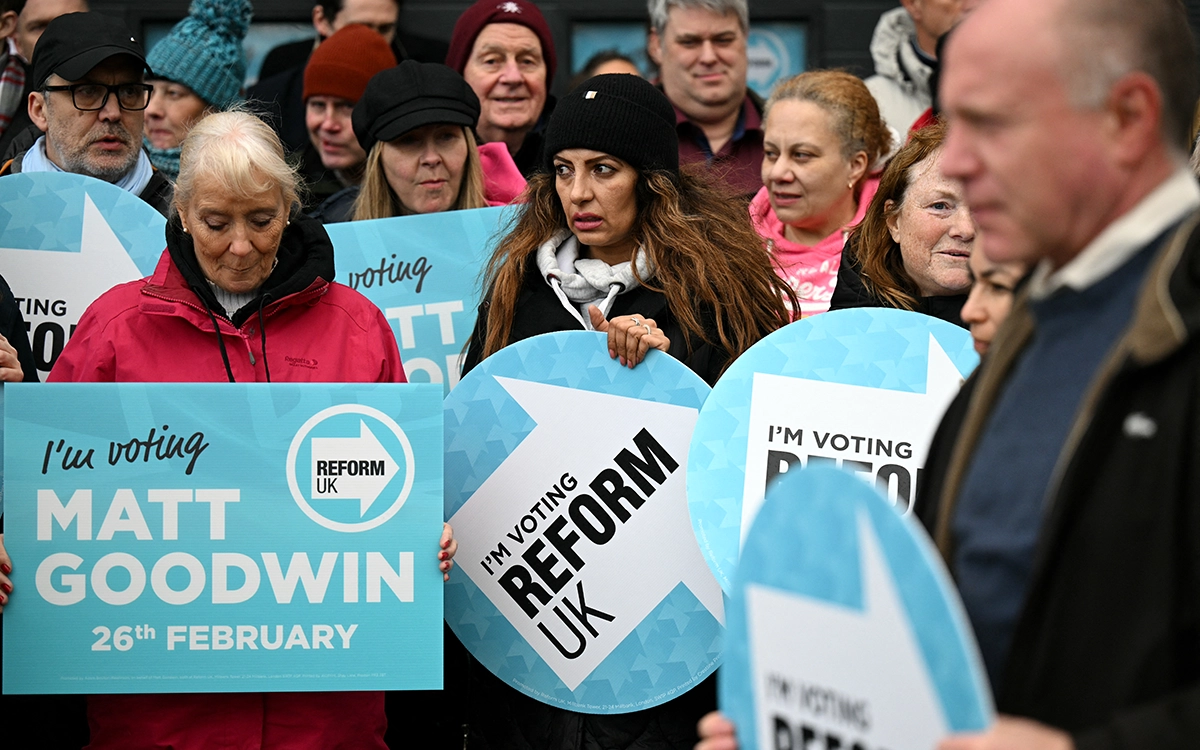
Where Reform Goes From Here
Four plausible trajectories emerge.
A Farage-Centered Hybrid Consolidation
Reform consolidates into a hybrid force: populist in rhetoric, institutional in practice. In this scenario, defected Conservatives provide organizational competence and parliamentary experience while Farage functions as the symbolic guarantor of anti-establishment authenticity. His personal authority reframes defections not as co-optation but as validation of his critique of Conservative decay.
This model allows Reform to professionalize without immediately forfeiting its insurgent identity, but it is also structurally fragile. A party’s dependence on one individual creates succession vulnerabilities.
Deferred Identity Crisis
Many voters care less about institutional provenance than about the articulation of grievance. So long as Reform’s representatives speak credibly to issues such as immigration and cultural alienation, their establishment backgrounds remain tolerable.
That tolerance, however, is conditional. As Reform confronts the constraints of governance, the party crosses a perceptual threshold. Organizational pedigree re-enters the frame, and Reform comes to be seen less as a rupture than as a reconfiguration of familiar politics. Internal tensions between grassroots activists and defectors sharpen, turning rhetorical assurances about candidate selection into concrete tests of credibility.
Electoral Expansion through Managed Moderation
A third path involves Reform expanding its appeal through selective policy moderation while retaining an oppositional posture. Recent shifts in policy visions suggest an attempt to signal governing seriousness without abandoning systemic critique.
If executed coherently, this strategy broadens Reform’s appeal beyond its protest base, particularly as Labour and the Tories struggle to win back public trust. The risk is miscalibration. Excessive pragmatism dilutes distinctiveness, while insufficient pragmatism confines Reform to symbolic opposition. The party’s success depends then on its ability to articulate policies that remain recognizably Reform while also proving operationally credible.
The party’s success depends on its ability to articulate policies that remain recognizably Reform while also proving operationally credible
Popularity Risk from Defections
While defections can bring experience and visibility, they also feed perceptions of opportunism. Voters who backed Reform for its insurgent identity might come to see it as “Tories 2.0,” constraining momentum and rendering headline leads fragile. This dynamic sharpens the tension between electoral ambition and populist authenticity.
The most likely of these trajectories is a Farage-centered hybrid consolidation. Reform manages its paradox by accepting defectors into its ranks, while Farage’s personal authority—and his communication skills—preserve the party’s outsider appeal. However, the durability of this arrangement will determine whether Reform can transition from protest movement to governing force, or whether institutionalization ultimately erodes the appeal that fueled its rise.