


The decision by a Belgian court to allow criminal proceedings over the 1961 assassination of Patrice Lumumba marks more than a delayed legal reckoning. It reflects a shift in political leverage, as the Democratic Republic of Congo (DRC) gains new grounds to challenge European influence and assert a more autonomous position. It represents a deeper shift in the balance of historical accountability between Europe and Africa, one that increasingly reflects African agency in shaping narratives once dominated by former colonial powers. In a context of unresolved imperial legacies, the DRC seeks to reposition itself within a rapidly changing geopolitical order.
The decision by a Belgian court over the assassination of Patrice Lumumba represents a deeper shift in the balance of historical accountability between Europe and Africa
The case is not simply about assigning responsibility for a political assassination. It is about whether international justice can meaningfully address the systemic forces that shaped post-colonial Africa, and whether European states are prepared to confront the enduring consequences of their actions. As such, the Lumumba case has become a prism through which broader questions of sovereignty, legitimacy, and geopolitical leverage are being renegotiated.
Case Against Belgian Official Takes Shape
In 2023, Belgian prosecutors moved to bring a criminal case against a surviving former Belgian official linked to Lumumba’s killing. The individual, Étienne Davignon, a 93-year-old former diplomat, is accused of complicity in unlawful detention and transfer, actions that contributed directly to Lumumba’s execution in January 1961. The charges stem from a long-running investigation launched after a 2011 complaint by Lumumba’s family.
The legal process has unfolded slowly due to the complexity of the case and its political sensitivity. Belgian courts had previously dismissed earlier attempts to prosecute, citing jurisdictional and evidentiary challenges. However, the persistence of Lumumba’s relatives, combined with shifting political attitudes in Belgium, has now produced renewed judicial momentum.
The case builds on earlier acknowledgments of responsibility. A 2001 Belgian parliamentary inquiry concluded that Belgium bore “moral responsibility” for Lumumba’s death. In 2022, Belgian authorities returned a gold-capped tooth believed to be Lumumba’s only surviving remains. These gestures, however, stopped short of legal accountability.
What distinguishes the current proceedings is their attempt to translate historical admission into criminal liability. Even so, the scope remains limited. The trial targets individual actions rather than the broader network of political, economic, and intelligence actors involved in Lumumba’s removal. In this sense, the case highlights a structural limitation: legal accountability is being applied to discrete actions while the wider system that enabled them remains out of its reach. This raises fundamental questions about whether the law, as currently structured, can address crimes rooted in imperial systems.
What distinguishes the current proceedings is their attempt to translate historical admission into criminal liability
Cold War Rivalries and Congo’s Political Crisis
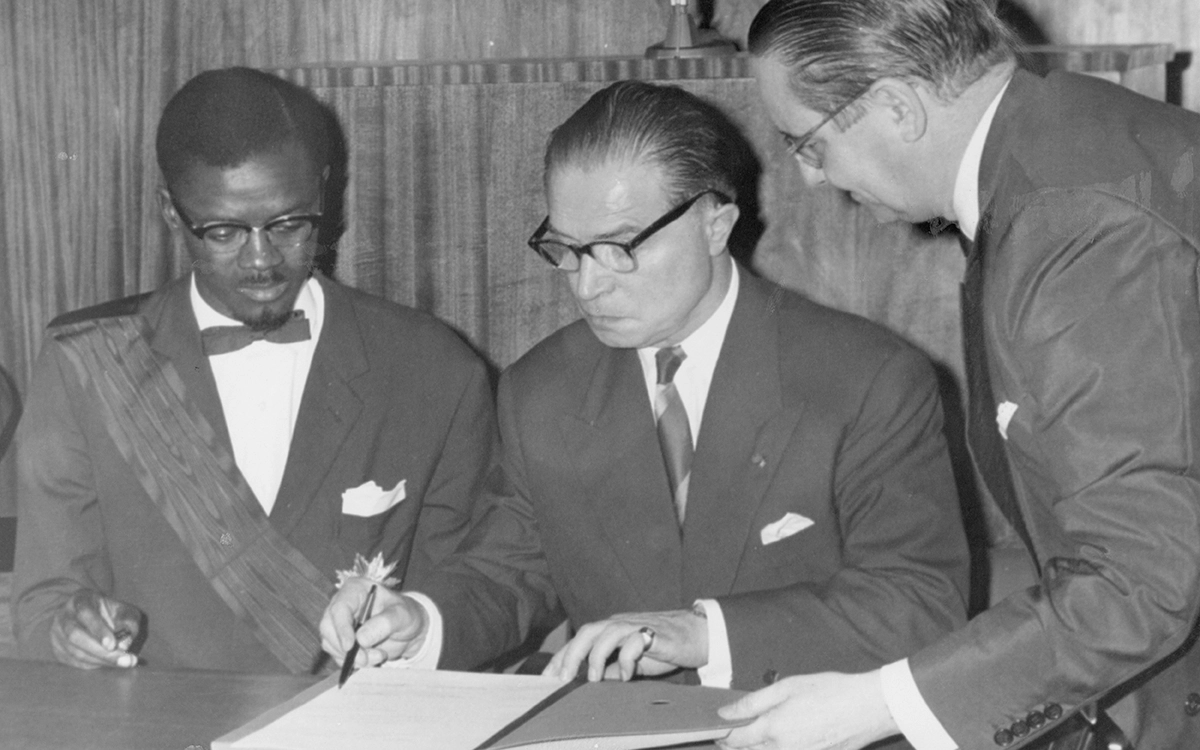
Lumumba’s assassination cannot be understood without the geopolitical context of Congo’s independence, a process through which Lumumba rose to prominence. As the country’s first Prime Minister in 1960, he represented a radical departure from the colonial order. Lumumba sought political sovereignty and economic independence for Congo, directly challenging Belgian control over the country’s vast mineral wealth.
Belgium’s interests in the Congo were deeply tied to mining operations, particularly in the resource-rich Katanga region. Companies such as Union Minière controlled access to copper, uranium, and other strategic resources. Lumumba’s push for national control over these assets threatened not only Belgian economic interests but also broader Western strategic calculations during the Cold War.
Faced with internal rebellion and external pressure, Lumumba turned to the Soviet Union for assistance. In the Cold War context, this was decisive. The move alarmed the United States and its allies, who interpreted it as a shift toward the Soviet sphere. According to declassified documents and findings from the United States Senate Church Committee, the CIA actively explored plans to remove Lumumba from power, viewing him as a potential Soviet proxy in Central Africa.
These Cold War dynamics contributed to a convergence of interests among Belgian officials, Congolese rivals, and Western intelligence agencies. Lumumba was arrested, transferred to Katanga, and executed on January 17, 1961, by separatist forces, with Belgian officers present. His body was subsequently dismembered and dissolved, an act that underscored the brutality of the operation and the lengths taken to erase his legacy. Ultimately, his killing was the product of overlapping interests—Belgian colonial concerns, Western Cold War strategy, and domestic political struggle—rather than a single isolated cause.
Structural Violence, Not Just Crime
The legal framing of Lumumba’s assassination as a matter of individual culpability risks obscuring its deeper structural dimensions. The events of 1961 were not an isolated act, but the outcome of systemic forces embedded in colonial governance and Cold War geopolitics.
Belgian colonial rule in the Congo systematically prioritized extraction over institutional development, leaving the state with limited administrative capacity at independence. This institutional vacuum made the new state vulnerable to internal fragmentation and external manipulation. Lumumba’s removal should be understood as part of a broader effort to maintain control over strategic resources and political alignments. The involvement of multiple actors, including foreign governments and multinational corporations, complicates efforts to assign responsibility within a conventional legal framework.
The trial thus raises a critical question for contemporary international justice: legal accountability can target individuals, but can it meaningfully address harms that are collective, transnational, and deeply embedded in historical structures? The Lumumba trial suggests both the possibilities and limitations of such efforts.
Historical Justice and State Legitimacy
For the DRC, the pursuit of justice for Lumumba is directly linked to questions of state legitimacy. His assassination is widely regarded as a foundational trauma, marking the violent interruption of the country’s first experiment with independent governance. The effort to address this history has become an important component of DRC national identity and political discourse. Yet the case also resonates with broader efforts across Africa to confront colonial legacies, from demands for reparations to campaigns to return cultural artifacts.
However, symbolic accountability does not resolve structural constraints in contemporary governance. While symbolic acts strengthen national cohesion and provide an abstract sense of historical justice, they do not automatically translate into institutional reform. The DRC continues to face significant challenges, including armed conflict in its eastern regions, weak state capacity, and contested political authority.
The risk is that a narrowly focused trial could create the appearance of closure while leaving the underlying conditions that have perpetuated instability unchanged. In this sense, for justice to contribute meaningfully to legitimacy, it must be accompanied by broader efforts to strengthen governance, assert sovereignty, and resolve historical injustices. Such efforts could demands for reparations, increased regulatory pressure on contemporary European firms operating in the DRC, and institution-building in historical memory (libraries, museums) that contrasts contemporary sovereignty with past injustice.
For justice to contribute meaningfully to legitimacy, it must be accompanied by broader efforts to strengthen governance, assert sovereignty, and resolve historical injustices
Rising African Agency in Global Power Politics
Despite these challenges, the Lumumba case unfolds within a broader shift in which African states are asserting greater control over external relationships, vying for more influence within the global order. As they assert agency in shaping international narratives, they also demand accountability from former colonial powers. In the DRC, this shift is evident in both rhetoric and policy. The government has sought to diversify its international partnerships, engaging with a wider range of actors beyond traditional European allies. Its economic ties with China and the United Arab Emirates, particularly in the mining sector, have expanded.
This diversification is not merely economic; it represents a strategic effort to reduce dependence on any single external partner and to leverage competition among global powers to increase room for maneuver. In this context, the Lumumba trial reinforces that shift. By foregrounding historical accountability, it strengthens the DRC’s position in challenging established relationships and renegotiating terms of engagement with European actors. It is also a reminder of the historical costs of external intervention, which reinforces the importance of sovereignty in contemporary policy.
At a continental level, the case aligns with similar dynamics in growing demands for the restitution of artifacts, reparations, and a reassessment of the assumptions that have long underpinned relationships with Europe. These efforts reflect a broader move toward recalibrating Africa’s place in the global system away from the residue of colonial-era arrangements.
Europe Faces a Critical Test of Credibility
For European states, the Lumumba case poses a significant test of credibility. Belgium, in particular, must navigate the tension between its historical role in the Congo and its current diplomatic and economic engagement.
For European states, the Lumumba case poses a significant test of credibility
The outcome of the trial will be closely watched across Africa. A process perceived as transparent and meaningful could help rebuild trust and create the basis for a more equitable partnership. Conversely, a limited or inconclusive outcome may reinforce skepticism about Europe’s willingness to confront its past.
More broadly, the case highlights the need to re-evaluate Europe’s approach to Africa. Traditional models of engagement, often characterized by asymmetrical power relations, are being challenged by a more assertive and diversified African diplomacy, which is increasingly possible in the emerging multipolar world. The European Union has countered such moves through initiatives aimed at strengthening partnerships and promoting investment in the continent. However, these efforts must be accompanied by a genuine acknowledgment of historical injustices if they are to succeed.

Expanding International Accountability
The Lumumba trial also has implications for the future of international justice. It raises questions about the extent to which legal systems can address historical crimes involving multiple states and actors. On one hand, the case demonstrates that accountability may be possible, even decades after the events in question. On the other hand, it underscores the limitations of existing frameworks, which are often ill-equipped to deal with systemic and transnational harms.
This distinction matters beyond the courtroom. It is particularly relevant in the context of the Great Lakes region, where historical grievances and external interventions continue to shape contemporary conflicts. By pursuing justice for Lumumba, the DRC is not only addressing a past wrong but also challenging the conditions that have contributed to ongoing instability, well beyond the DRC’s borders. In this sense, the trial can be seen as part of a broader effort to redefine the terms of engagement between Africa and the rest of the world. It highlights the growing importance of historical narratives in shaping geopolitical strategies.
History’s Enduring Influence
The Belgian court’s decision to move forward with a trial related to Lumumba’s assassination reflects a broader shift in the relationship between Africa and Europe. It is not only a legal development, but a political one, with implications for how historical accountability will be approached in the future.
For the DRC, the case offers an opportunity to strengthen its position and reclaim its narrative, asserting its place within a rapidly changing global order. For Europe, it presents a challenge—it tests the extent to which influence can be sustained while acknowledging both historical responsibility and contemporary realities.
Ultimately, the significance of the Lumumba trial lies not in its legal outcome alone, but in what it reveals about the evolving dynamics of power, justice, and sovereignty. More than sixty years after his death, Lumumba’s shadow continues to loom over the present, reminding the world that the legacies of empire are neither distant nor resolved.
The significance of the Lumumba trial reveals the evolving dynamics of power, justice, and sovereignty