As the second quarter of the 21st century kicks off, global trade has taken on new meaning in a volatile geopolitical landscape. After several decades of relative geopolitical harmony grounded in the post-Cold War order, trade relations now appear far more dominated by tariff conflicts, security concerns, and political leveraging.
With the apparent American withdrawal from its leadership role in the liberal world order and its general reorientation toward domestic and hemispheric concerns, the United States is implementing new immigration criteria and placing constraints on external access to its attractive market. Longtime trade partners face increasingly conditional access to American markets as President Trump’s tariffs entail high export costs. To compensate, partners are exploring new avenues outside the U.S.-led framework.
Facing increasingly conditional access to American markets and tariffs, trade partners are exploring new avenues outside the U.S.-led framework
Canada–China Trade Deal
Emblematic of recent trade diversification is the recent landmark deal reached between Canada and China. Canadian PM Mark Carney‘s trip to Beijing—the first of its kind since 2017—produced a comprehensive strategic reset in Canada–China trade relations, expanding cooperation in energy, clean technology, and climate competitiveness while also improving trade conditions for agri-food products.
The deal secures much-needed markets for Canadian canola products. The United States has been Canada’s top export destination for canola products, with exports valued at CAD $7.7 billion in 2024, followed by China, where canola exports totaled CAD $4.9 billion. Yet China lags far behind the U.S. in terms of total annual trade with Canada.
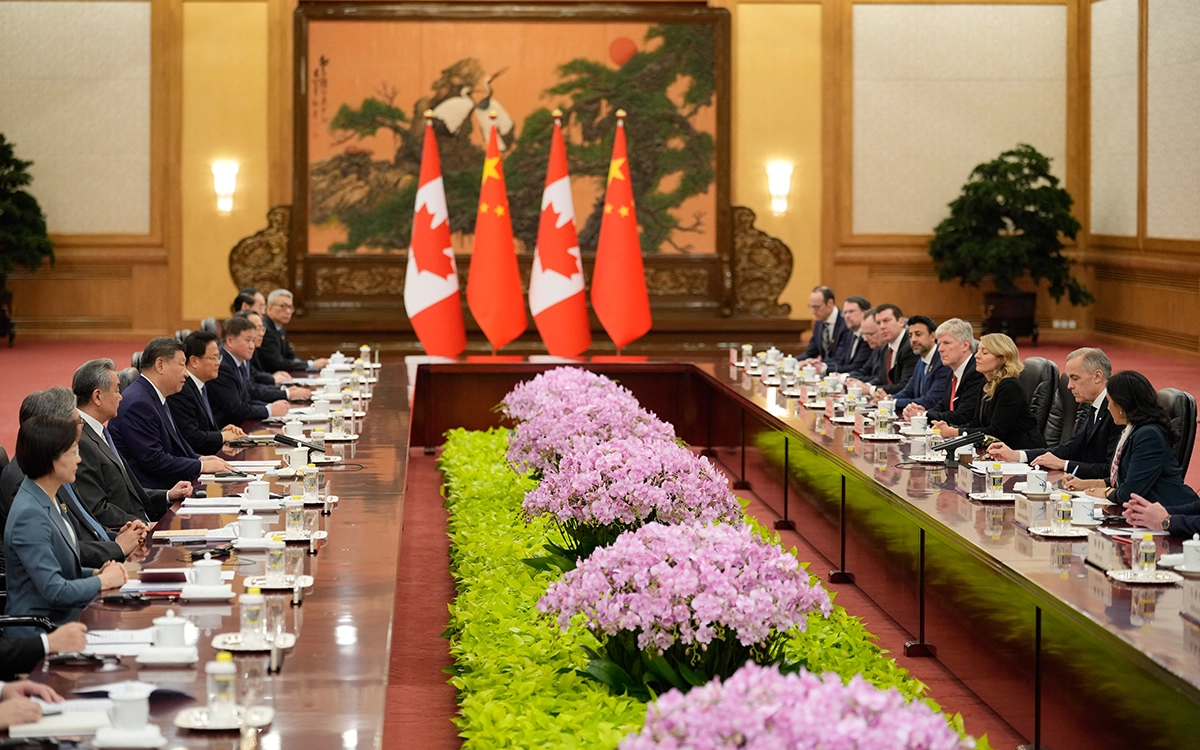
However, Canada–China trade relations have been fraught in the past few years. In August 2024, Canada announced tariffs on Chinese electric vehicles, steel, and aluminum, triggering Chinese anti-discrimination and anti-dumping investigations into imports of Canadian canola products. China subsequently imposed a 100 percent tariff on Canadian canola oil and canola meal from mid-March onward and a 75.8 percent duty on canola seed imports from August 2025.
By rolling back tariffs, the Canada–China strategic reset has bucked the broader trend of tariff escalation. China can now export up to 49,000 EVs to Canada at a preferential tariff rate of 6.1 percent, down from a previous 100 percent surcharge. Likewise, Canada expects China to reduce tariffs on canola seed to a combined rate of approximately 15 percent, from roughly 84 percent.
Moreover, Canada has set an ambitious new goal to increase its exports to China by 50 percent by 2030 as part of its bid to diversify trade partnerships amid turbulent geopolitical developments. Both countries also agreed to continue working in the coming months on additional trade irritants of economic importance.
The deal gains particular significance given that the U.S., Canada’s largest trading partner, suspended all trade talks after Ontario’s Premier Doug Ford ran an anti-tariff advertisement. After assuming office for a second term, Trump imposed tariffs on nearly all U.S. trading partners on the so-called “Liberation Day,” introducing uncertainty into world capitals and global markets.
Citing massive U.S. trade deficits with partners, Trump labeled these tariffs “reciprocal” and drew governments around the world to Washington to renegotiate trade agreements. Trump has largely employed tariffs as a diplomatic tool to secure what he deems more favorable trade terms for the United States. The tactic also extends to his domestic and foreign policies. He escalates matters to throw opponents off balance and then exploits the situation to seal a better deal. Canada–U.S. relations have soured in general ever since the U.S. president attacked Canadian sovereignty, floating the idea of making Canada the 51st state.
Canada–U.S. relations have soured in general ever since the U.S. president attacked Canadian sovereignty, floating the idea of making Canada the 51st state
EU–Mercosur Deal
The European Union and the Latin American Mercosur bloc signed a free trade deal on January 9, creating the world’s largest free trade zone, which includes more than 700 million consumers.
The deal, in the making for the past 20 years, broadens the EU’s trade horizons in light of geopolitical realities—the EU’s frozen ties with Russia, complications in its partnership with China, and Trump’s tariff onslaught since last year. Together, these factors have narrowed the global marketplace for any bloc to expand trade.
Following the deal, European Commission President Ursula von der Leyen said, “With this win-win partnership, we both stand to gain—economically, diplomatically, and geopolitically. Our companies will create exports, growth, and jobs. We will support each other in our clean and digital transitions. It is our signal to the rest of the world,” she added, “that the EU and Mercosur are choosing cooperation over competition, and partnership over polarization.”
The move suggests European nations are coordinating diversification efforts while reinforcing traditional trade routes with existing partners. Nonetheless, the EU–Mercosur deal faces domestic hurdles at home, since the European Parliament referred it to the European Court of Justice to evaluate its conformity with other EU treaties.
EU–Mexico Agreement
On the same day, the EU and Mexico also concluded negotiations on a modernized Global Agreement, which will update their 2000’s EU–Mexico partnership. “The agreement facilitates strategic cooperation on key geopolitical issues, keeping up with fast-changing realities. This includes de-risking supply chains, securing a sustainable supply of critical raw materials, and tackling climate change,” read an EU press release.
These agreements attest to an incremental diversification underway amid a transitioning world order, marked by the growing structural primacy the United States and China. Middle and smaller powers are adapting to that structure in order to avoid dependency, increasing sovereign bilateral transactionalism, decoupling, and hedging against overreliance.
Italy’s Attention Shifts to Asia
On January 14, Italian Prime Minister Giorgia Meloni launched her six-day tour of Asia with stops in Oman, Japan, South Korea, and Uzbekistan.
Meloni first paid a visit to the Sultan of Oman, where she discussed ways to strengthen bilateral relations and expand areas of cooperation in trade, investment, and industry, among other geopolitical matters.
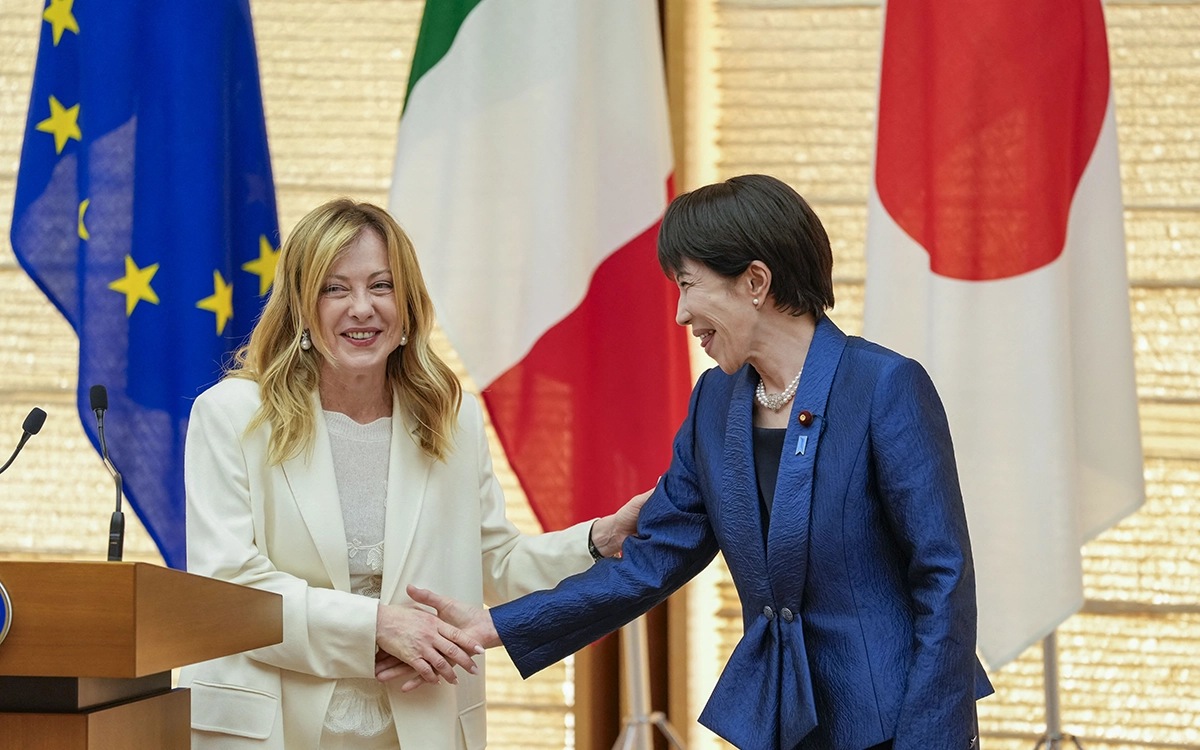
After that, Meloni marked 160 years since the establishment of diplomatic relations between Italy and Japan. On the occasion, she co-authored an opinion piece with Japanese PM Sanae Takaichi on “Italy–Japan: 160 years of vision,” published simultaneously in Italian and Japanese newspapers. In the joint op-ed, they note, “The digital revolution, the energy transition, the rise of AI, competition for strategic resources, and the redefinition of global value chains are shaping a new global order. In this context, Italy and Japan can play a leading role. We share a responsibility to help shape the future international order.”
The op-ed suggests that Italy and Japan are taking note of the United States’ retreat from a wider global role. Together, they seek to assert themselves “on the global stage to defend a free, fair, and open international order” in ways available to them.
In 2022, Italy, Japan, and the United Kingdom initiated a joint defense project. Their one-of-a-kind Global Combat Air Program shares a common ambition of developing the next-generation future fighter aircraft by pooling the expertise of their technologically advanced industries. This independent endeavor, outside the U.S. military-tech sphere, indicates these nations’ prioritization of defense amid shifting global security dynamics.
Next, Meloni headed to South Korea, where she sought cooperation in key sectors such as artificial intelligence, aerospace, semiconductors, and critical raw materials. The visit, the first of its type in nearly 20 years, suggests Italy is reevaluating key tech markets and seeking alternative solutions for its tech needs.
Apart from discussing bilateral trade, foreign investment, and supply chains, Meloni and South Korean President Lee Jae Myung reiterated their commitments to multilateralism, international peace, and security. They also reaffirmed a commitment to the denuclearization of the peninsula, a significant move given Beijing’s recent pivot on the nuclear issue.
Together, these trade deals signify the extent to which the global trade order is diversifying amid growing U.S.–China competition and lingering doubts about the future of the transatlantic alliance. Diversification will likely remain the key agenda for most nations for the foreseeable future, as fears of geopolitical volatility persist.
Diversification will likely remain the key agenda for most nations for the foreseeable future, as fears of geopolitical volatility persist
Davos Economic Forum
The Davos Summit took place amid a general unease among European leaders, who faced mounting pressure from Trump on Greenland in the run-up to the event. Prior to his travel to Davos, Trump threatened several European nations with additional tariffs for opposing his Greenland designs and criticized the UK for returning an island that hosted U.S. and UK military bases since the 1970s to Mauritius.
During the summit, while re-emphasizing the U.S. role in European and world security and the importance of Greenland to the U.S. in countering rivals China and Russia, Trump further stoked tensions by doubling down on his intention to acquire the Arctic island. At stake in the Greenland issue are Denmark’s territorial sovereignty and the continuation of the transatlantic alliance.
A day before Trump’s arrival, Canadian PM Carney delivered a revealing speech on the contemporary geopolitical environment: “More recently, great powers have begun using economic integration as weapons, tariffs as leverage, financial infrastructure as coercion, supply chains as vulnerabilities to be exploited,” Carney noted, adding that “Hegemons cannot continually monetize their relationships. Allies will diversify to hedge against uncertainty.”
The Mother of All Deals
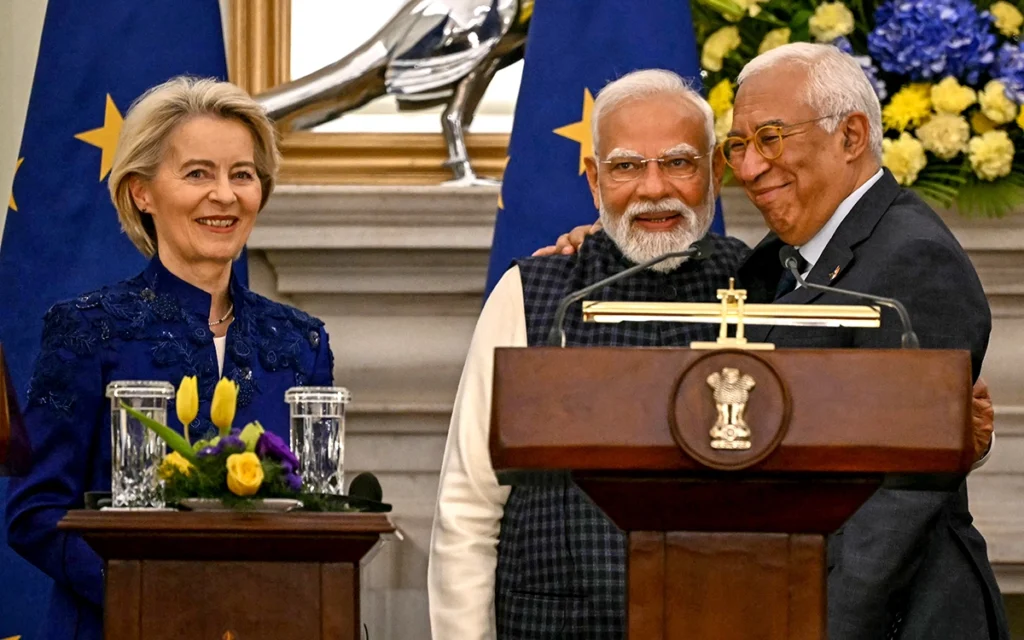
In the spirit of diversification, the EU and India signed another major free trade deal this week, dubbed the “mother of all deals,” hedging their exposure to both the U.S. and China while boosting mutual trade. Together, India and the EU represent nearly 25 percent of global GDP and a market of two billion people, unlocking massive potential for two-way trade.
As per the agreement, the EU will eliminate more than 90 percent of tariffs on Indian imports, and India will eliminate duties on 86 percent of EU goods, benefiting key economic sectors, including agri-food, chemicals, pharmaceuticals, machinery, avionics, automotive industries, textiles, and footwear. Moreover, the two sides have agreed to a phased elimination of the remaining tariff lines, expanding the overall free trade coverage to 96.6 percent for India and 99.3 percent for the EU.
The market size and vast reduction in tariffs indicate that trade between the two partners will grow substantially in the next few years. Yet, both sides have clearly excluded certain products and sectors from this deal, preserving policy space for them due to internal sensitivities. To protect European farmers, the EU has maintained existing duties on its sensitive products such as beef, sugar, ethanol, rice, and poultry. Similarly, to balance export and domestic priorities, India has kept safeguards for its own sensitive sectors such as dairy, cereals, poultry, soymeal, and certain fruits and vegetables.
The deal has immediate implications for certain sectors, such as the European automotive sector, which has been hit hard by cheaper Chinese electric vehicles dominating global market share and U.S. protectionist policies in the past few years. After the deal, Indian tariffs on European cars will be slashed to as low as 10 percent from 110 percent, a great relief to the EU’s major auto sector. The EU will now have privileged access to India, the world’s third-largest auto market, yet competition from rival auto industries remains cutthroat.
The deal also elicited a response from U.S. Trade Representative Jamieson Greer, who said, on Fox, “Because President Trump has prioritized domestic production and essentially started charging a fee for other countries to access the U.S. market, these countries are trying to find other outlets for their overproduction.” He added, “It looks like the EU is doubling down on globalization when we are trying to fix some of the problems of globalization here in the US.”
The U.S. administration has enforced 50 percent tariffs on Indian goods, restraining the country’s trade and exports since last year. Of that total, 25 percent represents a punitive tariff on India for purchasing sanctioned oil from Russia. With the deal, both the EU and India are set to benefit, hedging against exposure to American volatility and establishing a new partnership to sustain and expand trade.
The EU and India are set to benefit, hedging against exposure to American volatility and establishing a new partnership to sustain and expand trade
Diversification in a Volatile Trump-led World
Though the EU signed a deal with Trump last year, it has failed to sustain the expected stability and predictability. European nations repeatedly find themselves rattled by the U.S. president’s tariffs, which often begin as whimsical threats. Earlier, Trump threatened to impose 200 percent tariffs on French champagnes and wines in order to push French President Emmanuel Macron to join his Board of Peace on Gaza. Given Trump’s unpredictability, it remains difficult to discern which lighthearted threats will become retributive realities.
The recent diversification bids are a testament to nation-states’ striving to reestablish a new balance in a volatile global market fraught with diplomatic conflict. They resemble efforts to seal the cracks in the incumbent world order after a rupture, and perhaps lay the foundation for a new one.