
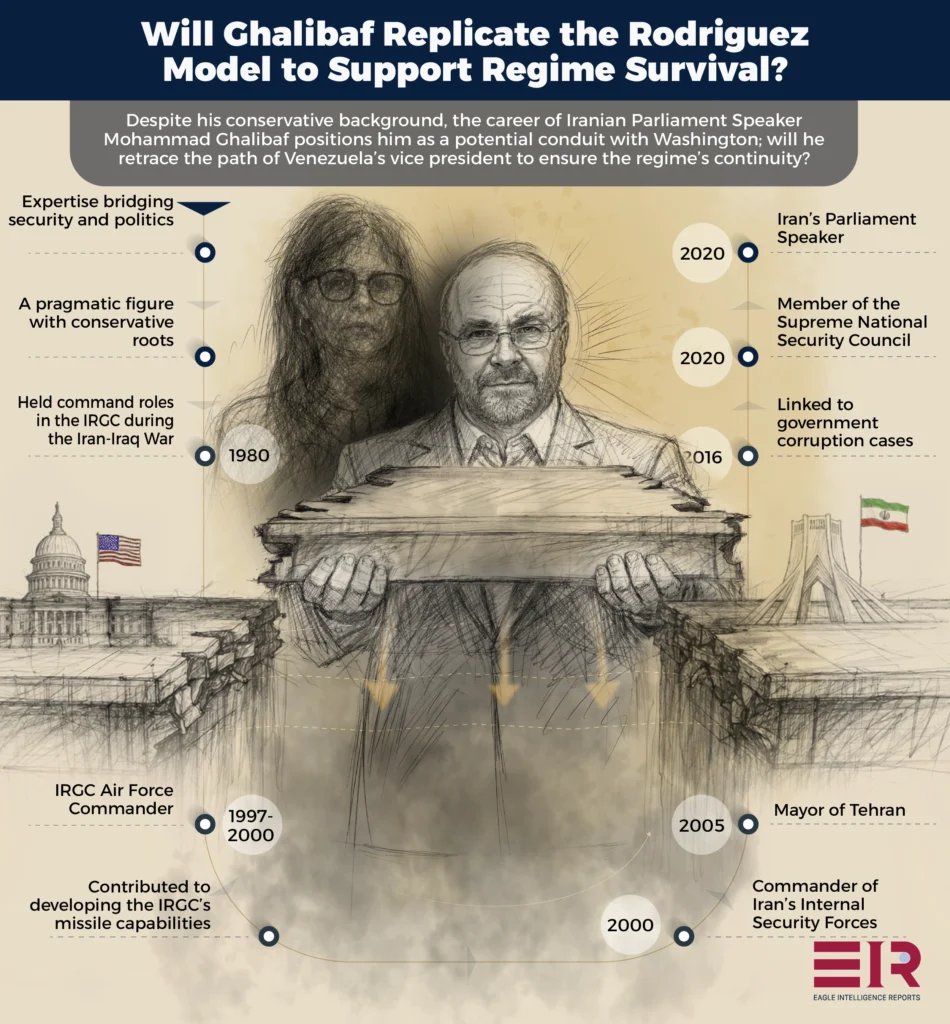
Recently, the name of Mohammad Bagher Ghalibaf, the speaker of the Iranian Parliament, has emerged prominently in political and diplomatic deliberations, particularly following American signals that he is a potential partner in the post-war era, capable of engaging in a new political track with Washington.
Some analyses suggest that Washington might be counting on Ghalibaf to play a role similar to that of Delcy Rodríguez in Venezuela—as an internal figure capable of managing negotiations and sustaining them through a more flexible approach.
Conversely, Tehran denies the existence of any ongoing negotiations. Foreign Minister Abbas Araghchi stressed that discussing negotiations at the moment would be “an admission of defeat,” given the ongoing military strikes and the leadership vacuum.
Despite this, real power in Iran remains distributed throughout multiple nodes of authority. The Supreme Leader retains ultimate decision-making power, while the Islamic Revolutionary Guard Corps (IRGC) remains the most prominent actor on the ground, making any political transformation dependent on complex internal power dynamics.
In this context, Ghalibaf stands out as a figure combining security expertise with political presence. His statements during the war reflected a discourse that went beyond the parliamentary framework, reinforcing the impression of his growing influence.
But the most important question remains: Does Ghalibaf represent a viable channel for any political transformation, or will the structural complexities of the Iranian regime limit his role?