
Eagle Intelligence Reports

For much of the post-Cold-War era, Greenland existed at the margins of strategic thought. Immense in scale yet negligible in population, the island appeared to confirm a prevailing assumption of the 1990s: that geography had been eclipsed by markets, institutions, and technology as the primary drivers of power. In a world organized around global supply chains and digital connectivity, ice-covered landmasses seemed more symbolic than consequential.
That assumption has now collapsed. Geography has returned abruptly, propelled by climate change, renewed great-power competition, and the erosion of post-Cold-War restraint. Sea routes, chokepoints, and territory once again structure strategic planning. Greenland’s sudden prominence is therefore not an aberration caused by political eccentricity, but the logical result of deeper structural shifts—shifts that will continue to shape strategic behavior.
The Arctic’s return to geopolitical relevance has been widely noted but insufficiently analyzed. Climate change has altered not only environmental conditions but also strategic calculations. Melting ice has opened seasonal shipping routes, expanded access to resources, and increased the feasibility of sustained military presence. The Arctic is no longer a frozen buffer but an emerging theater.
The Arctic is no longer a frozen buffer but an emerging theater
Russia has acted accordingly. Over the past decade, Moscow has reopened Soviet-era Arctic bases, expanded its Northern Fleet, and invested heavily in ice-capable naval and missile systems. The Arctic has become integral to Russia’s strategic deterrent and power-projection capabilities. China, meanwhile, has pursued a quieter but persistent approach. Declaring itself a “near-Arctic state,” Beijing has invested in scientific missions, port infrastructure, and commercial partnerships across the polar north, framing its ambitions in economic and environmental terms while steadily expanding its political footprint.
For the United States, these developments transformed the Arctic from a secondary concern into a strategic priority. Greenland occupies a central position in this recalculation. Its location astride the Greenland–Iceland–United Kingdom (GIUK) gap gives it enduring relevance to North Atlantic defense. The early-warning radar and missile defense infrastructure at Pituffik Space Base remains essential to U.S. and NATO space surveillance and ballistic-missile detection. Control over access, infrastructure, and cooperation in Greenland is therefore operational.
These realities explain why Greenland has long featured in U.S. defense planning—and why interest in the island long predates Donald Trump. What changed in 2026 was not American awareness of Greenland’s value, but the method through which Washington sought to assert influence there.

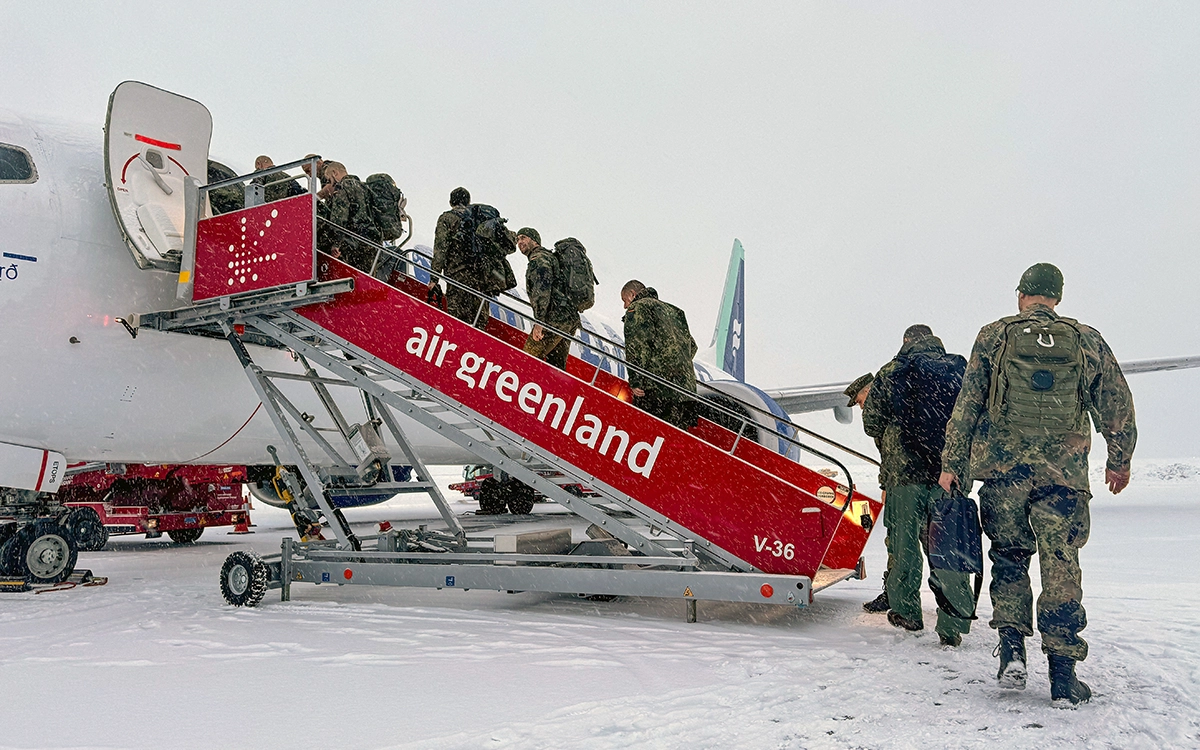
U.S. policy toward Greenland shifted from diplomatic signaling to overt pressure. Public statements about acquisition, threats of tariffs on European goods against NATO allies who rightly objected American coercion, and deliberately ambiguous references to military access were deployed to force movement from allied capitals. The language was explicit rather than coded. “We need Greenland for international security,” President Trump declared, adding that the United States would obtain “total access” one way or another. The statements were so concerning that Denmark and other NATO states deployed a small but symbolic contingent of troops to the island—not to deter Russia or China, but the United States.
However, Trump’s rhetoric is not merely excess. It reflects a governing philosophy that treats international politics as a series of transactions, in which leverage substitutes for legitimacy and spectacle trumps process. In this worldview, power is demonstrated by forcing visible concessions rather than by sustaining institutions.
The announcement at the World Economic Forum in Davos of a “framework for a forthcoming agreement” exemplified this approach. The phrase implied progress without substance. No text was released. No signatories were identified. No terms were specified. The declaration functioned less as a diplomatic milestone than as a narrative device designed to project momentum while preserving—once again—ambiguity. Such tactics can succeed when targets are weak, isolated, or internally divided. They are far less effective when deployed against allies embedded in dense institutional frameworks. Greenland is not a free-floating asset but part of a legal, constitutional, and alliance architecture designed precisely to prevent unilateral coercion.
Greenland is not a free-floating asset but part of a legal, constitutional, and alliance architecture designed precisely to prevent unilateral coercion
In this context, Greenland’s status is often misunderstood. It is neither an independent state nor a colonial dependency in the classical sense. It is a self-governing territory within the Kingdom of Denmark, with extensive autonomy and a legally codified right to self-determination.
Danish sovereignty over Greenland was affirmed in 1933 by the Permanent Court of International Justice and has since been reinforced through United Nations practice, NATO membership, and a series of bilateral treaties. Most significant is the 1951 U.S.–Denmark Defense Agreement, which grants the United States extensive operational access while explicitly preserving Danish sovereignty. The agreement allows Washington to establish and operate military facilities, conduct defense activities, and coordinate regional security—but it does not transfer ownership or decision-making authority.
Domestically, the 2009 Self-Government Act grants Greenland control over internal governance, natural resources, and wide areas of economic policy. It affirms the Greenlandic people’s right to independence, but that right is procedural rather than unilateral. Any move toward statehood requires negotiation with Denmark and recognition under international law. There is no legal mechanism by which Greenland can be transferred to another state without the consent of both Copenhagen and Nuuk, followed by international acceptance.
These constraints are not symbolic but functional; they form the legal infrastructure that governs Arctic security. By framing its ambitions in terms of acquisition rather than cooperation, the Trump administration placed itself outside this very infrastructure.
Accordingly, Denmark’s response to the pressure campaign was notable for its restraint. Rather than escalate rhetorically or attempt to appease Washington, Copenhagen adopted a strategy of disciplined clarity. Two issues were separated with surgical precision: security cooperation and sovereignty. On the former, Denmark signaled openness. It reaffirmed its commitment to NATO, expressed willingness to expand Arctic security cooperation, and welcomed structured dialogue on shared defense concerns. On the latter, it closed the door entirely. “Greenland is not for sale,” Prime Minister Mette Frederiksen stated flatly. There would be no negotiation over territory.
This distinction was crucial. By refusing to blur security cooperation with sovereignty, Denmark limited Washington’s ability to frame concessions as pragmatic compromise. The language was deliberately spare, avoiding emotional appeal or moral grandstanding. In doing so, Copenhagen deprived the U.S. administration of the spectacle it sought.
Equally important was coordination with Nuuk. Greenland’s government echoed Denmark’s position almost verbatim, emphasizing that autonomy does not equate to strategic vulnerability. This unity prevented any attempt to exploit perceived divisions between Danish authorities and Greenlandic leaders—a tactic implicitly suggested in public references by the White House to “what Greenland wants.” In reality, Greenland’s leadership understood that any erosion of Danish sovereignty would weaken, not enhance, their long-term autonomy.
Greenland’s leadership understood that any erosion of Danish sovereignty would weaken, not enhance, their long-term autonomy
However, what transformed the episode from a bilateral dispute into a systemic test was Europe’s response. Its capitals moved with unusual speed to frame the issue as a challenge to alliance norms rather than a misunderstanding between partners. The concern was not solely Greenland’s intrinsic value but the precedent that would be established if a U.S. president could credibly threaten to annex territory of allies, undermining the internal logic of NATO and the European Union alike, and forcing smaller states to hedge not only against adversaries but also allies.
European leaders therefore deployed the language of territorial integrity—sharpened by the continent’s experience with Russian aggression in Ukraine—to draw a clear line. “Only Greenland and Denmark can decide their future,” a joint statement declared. Borders within the alliance were not negotiable.
This rhetorical stance was reinforced by practical measures. The European Union quietly prepared potential countermeasures, including consideration of its anti-coercion instrument—the so-called “trade bazooka”—signaling that economic pressure would be met collectively. The abdication of appeasement proved particularly effective. By shifting the dispute into institutional channels, Europe forced the United States to operate within frameworks it had helped create or else essentially openly transform into a rogue state.
The subsequent cessation of Trump’s threats was perhaps the most revealing phase of the episode. The world did not witness a retreat from American interests, but a forced return to process. The rhetoric of purchase has been quietly replaced by the language of consultations, working groups, and technical dialogue. Washington, Copenhagen, and Nuuk agreed to structured talks focused on Arctic security, basing arrangements, and infrastructure access—precisely the issues that could have been pursued from the outset.
This recalibration mattered because it exposed the real limits of unilateral power within a dense alliance system. The United States remains the dominant military actor in the Arctic, with unmatched intelligence capabilities, logistical reach, and a long-standing presence at Thule Air Base. Yet none of these assets translated into political leverage once Denmark and Greenland framed the issue as one of sovereignty, treaty law, and alliance norms. The saga thus functioned as a stress test for the western alliance in the post–Cold War order.
It demonstrated that even a superpower struggles to impose outcomes when it bypasses the procedures that confer legitimacy. Access to territory, unlike control over supply chains or trade routes, cannot be coerced without incurring long-term costs; it must be negotiated, normalized, and embedded in law. Hence, this is not a story of American restraint so much as American adaptation. The administration did not abandon its strategic objectives but rather its counterproductive method. That distinction is critical.
Access to territory, unlike control over supply chains or trade routes, cannot be coerced without incurring long-term costs; it must be negotiated, normalized, and embedded in law
But to argue that the Greenland gambit was driven by a single strategic rationale might be wishful thinking. Rather, it likely reflected the collision of two distinct logics—one structural, the other personal.
The former has already been alluded to. As a geographic chokepoint, Greenland represents a critical node in early warning systems and sea lane access. Viewed through this lens, increased American engagement with Greenland was not controversial but overdue. Pentagon planners and intelligence officials have long argued that Arctic security has been neglected in favor of Middle Eastern counterterrorism and Indo-Pacific competition.
The second logic, however, follows a different grammar altogether. Trump’s public language—references to “buying” Greenland, promises of wealth and development, comparisons to the Louisiana Purchase—reflect a transactional understanding of geopolitics. In this worldview, foreign policy success is measured not by stable arrangements but by visible, symbolic gains. Territory matters less for what it enables than for what it signifies: dominance, decisiveness, legacy. This personal logic demands spectacle whereas strategic logic requires discretion. The two were incompatible.
Measured narrowly, the Greenland episode ended without catastrophe. No territory changed hands. No treaties were broken. Yet its implications extend beyond Greenland itself. The incident has strengthened European arguments for strategic autonomy—not as a project of separation from the United States, but as a form of insurance against American volatility. What is likely to follow is not decoupling but buffering: an effort to reduce exposure to uncertainty without abandoning the alliance. As Canadian Prime Minister Mark Carney warned in his Davos address, the Atlantic relationship has experienced a “rupture”—not collapse, but structural strain—and that condition is unlikely to be temporary.
Crucially, European leaders no longer appear willing to treat this volatility as an aberration to be endured until political normality returns to Washington. The strategy that prevailed during Trump’s first term—patience, reassurance, and the assumption of an eventual reset—has lost credibility and coherence. After all, the Republican field waiting in the wings for 2028 offers little reassurance. And even within the Democratic Party, transatlanticism can no longer be taken for granted, as the American electorate becomes increasingly receptive to isolationist instincts.
Seen in this light, the Greenland episode may yet prove to be a catalyst rather than a crisis. It forced European governments to articulate—perhaps for the first time with real conviction—the boundaries of acceptable American behavior within an alliance. For Greenland, the episode paradoxically enhanced its agency. Nuuk used the moment to assert its political maturity, making clear that decisions about independence, alignment, or basing rights would be made domestically and recognized internationally.
The Greenland episode may yet prove to be a catalyst rather than a crisis. It forced European governments to articulate the boundaries of acceptable American behavior within an alliance
The most probable near-term trajectory is not seizure but entanglement. Expect Washington to pursue durable, low-drama instruments: multilayered basing agreements couched as infrastructure and emergency-response partnerships; stepped-up investment in civilian projects that tie Greenland’s economy more closely to American suppliers; and interoperable communications and space and surveillance links that integrate Greenland into U.S. defense networks without altering formal sovereignty.
Annexation or a headline-grabbing purchase is politically toxic and legally impossible, making any renewed frontal bid extremely unlikely. What will recur, however, are episodic pressures and offers—carrots and conditionalities—designed to institutionalize influence quietly. That slow accretion of commitments will be the real bargain the West signs, and Greenland’s strategic position will harden not through a single transaction but through a sequence of interlocking obligations.
That outcome carries its own risks and responsibilities. Nuuk must convert newfound leverage into stronger statecraft: transparent revenue management, clearer procurement rules, and sustained investment in administrative capacity, so external capital does not necessarily entrench dependency. Copenhagen’s task, meanwhile, will be to safeguard political autonomy while ensuring that Danish and Greenlandic institutions can manage complex security partnerships.
Europe now faces the harder test: it must translate reactive unanimity into ongoing support—finance for civilian resilience, technical assistance, and a legal architecture that locks in Greenlandic agency. If those choices are made well, the High North will become a region of predictable, multilaterally governed access. If they are mishandled, Greenland risks being gradually absorbed into external networks of influence under the guise of partnership.
The strategic prize this year is therefore not territory, but the ability to shape the rules that determine how influence is exercised. Moving forward, such decisions will be made in committee rooms, investment boards, and ministries, not on a map.