

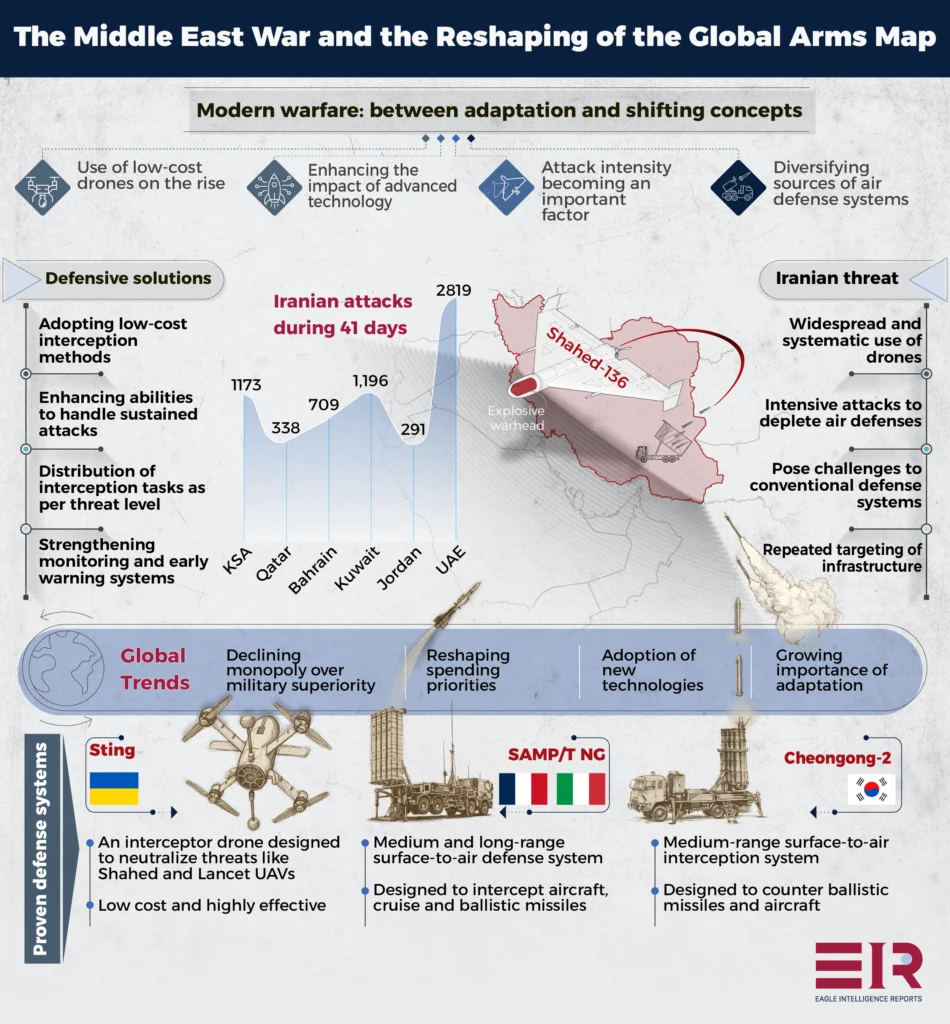
Recent developments in the Middle East demonstrate a clear shift in the arms landscape, wherein military superiority is no longer determined by the possession of the most advanced and expensive systems, but rather by the ability to employ low-cost weapons intensively and effectively. Drones and a number of defense systems have emerged as crucial elements capable of achieving significant impact at a limited cost.
In this context, the pattern of Iranian attacks on the Gulf states, Jordan, and Israel exemplifies this shift through the systematic and intensive use of drones to exhaust and overwhelm conventional air defense systems, resulting in disproportionate costs between defense and offense.
Therefore, the defensive response no longer depends on a single advanced system and is moving towards the development of multi-layered systems that combine highly efficient and low-cost solutions, such as interceptor drones, and through the introduction of new defensive systems to achieve a balance between response speed and the cost of interception, and diversification of weapons sources.
Thus, the global weapons map is moving towards a new model, based on the combination of density, integration, and operational flexibility, as the idea of a qualitative monopoly on military superiority declines in favor of systems more adapted to the changing nature of threats.