
Eagle Intelligence Reports
There’s an old saying in American military circles: Do not change horses in the middle of the stream. The axiom reflects some hard-learned lessons about what can go wrong when a country subordinates military prowess to backroom politics in selecting commanders during a war. The impact can ripple through the ranks and cause as much damage as a jammed rifle or a misguided missile.
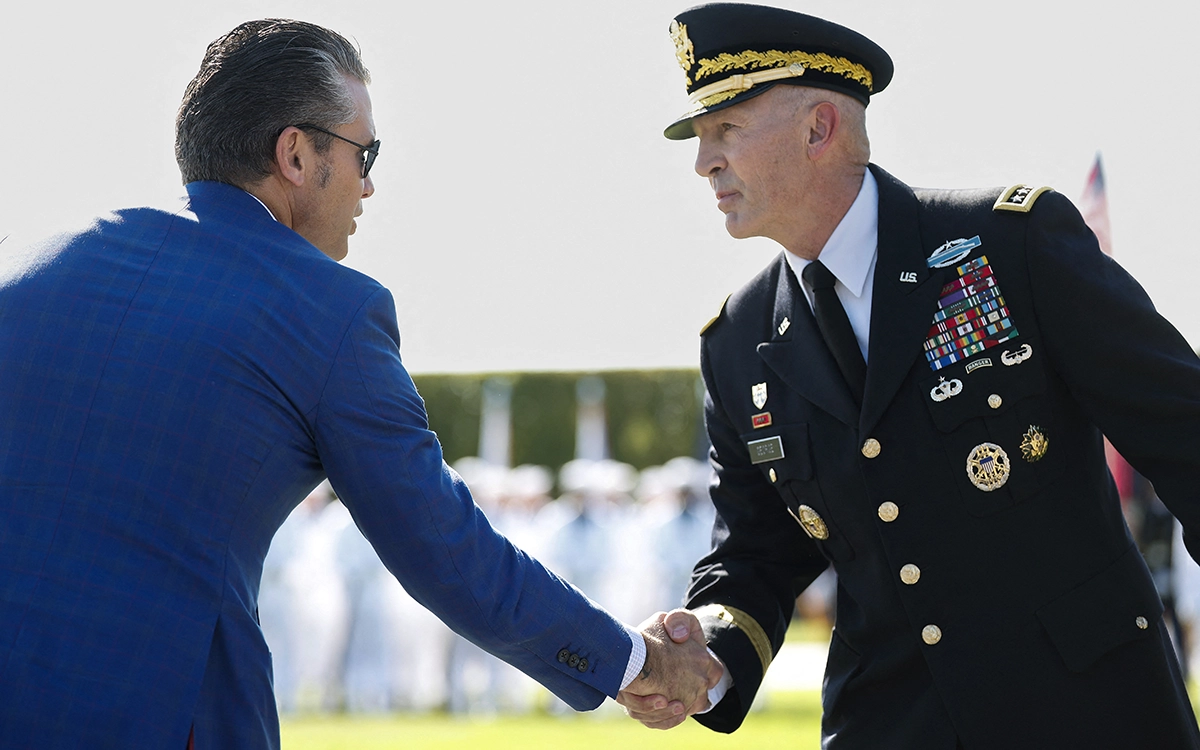
Secretary of Defense Pete Hegseth ignored that wisdom when he forced the departure of the Army’s top commander, General Randy George, the Army chief of staff, as war raged in Iran and thousands of troops from the 82nd Airborne deployed to battlefields near the Arabian Gulf. On the same day, he also dismissed Gen. David Hodne, who led the Army’s Transformation and Training Command, and Maj. Gen. William Green, the leader of the Army’s Chaplain Corps.
Hegseth sacked George before Trump agreed to a two-week ceasefire with Iran, but the breach of the tradition of supporting commanders during wartime mattered as much as the action itself. He offered no substantial explanation for ousting George, a widely respected combat veteran, or the others during a Pentagon purge that’s been underway for several months. Indeed, Hegseth also blocked the promotion of four colonels to the rank of brigadier general, reportedly for their association with “woke” policies that took race and gender into account while reviewing candidates for promotion. Two of the four were Black, and two were female.
Pentagon officials shed little insight when reporters asked about the actions, particularly the ouster of Gen. George. Instead, they offered the usual boilerplate language that often accompanies forced exits. However, Pentagon sources critical of the treatment of an officer of George’s caliber told reporters that Hegseth wanted someone in the role who would implement Trump and Hegseth’s well-publicized “anti-woke” vision for the Army. Gen. George had another perceived liability. He served as senior military assistant to former Gen. Lloyd Austin, Biden’s defense secretary and a frequent target of President Trump’s attacks.
In other words, the dismissals had more to do with politics than with experience or battlefield performance. There is little disagreement that promotions in the military should be based on merit and proven performance. The real question is whether that standard is being applied consistently, or used selectively to justify decisions shaped by political considerations. When officers are pushed aside not for how they have performed in command, but for how they are perceived to align on certain issues, merit risks becoming more of a talking point than a guiding principle. That is a departure from established norms and orthodoxy that carries serious consequences for the morale of the American military.
When officers are pushed aside not for how they have performed in command, but for how they are perceived to align on certain issues, merit risks becoming more of a talking point than a guiding principle
Throughout almost every military conflict in American history, the nation has maintained a principled, if sometimes strained, commitment to a military that avoids politics as much as soldiers shun surrender. Fidelity is not absolute; presidents appoint senior military leaders who share their vision for the defense of the country, and commanders-in-chief retain the authority to dismiss those who depart from it or perform poorly in combat. The stakes of failure are too high. Nevertheless, presidents or defense chiefs rarely initiate purges of senior commanders during active conflicts, when adversaries may interpret an abrupt change as signs of instability or opportunity.
There are exceptions to the norm of avoiding command changes during combat. When President Lyndon Johnson grew frustrated with the lack of progress in the Vietnam War, he replaced Gen. William Westmoreland, who was commander of U.S. troops there. Technically, LBJ did not fire Westmoreland; he moved him aside by promoting him to Army Chief of Staff and installing Gen. Creighton Abrams as commander in Vietnam. Commanders were replaced in World War II as well, and President Abraham Lincoln changed generals several times during the Civil War.
But the closest parallel to Gen. George’s treatment is President Harry Truman’s April 1951 dismissal of Gen. Douglas MacArthur. Although Truman fired MacArthur during the Korean War, the circumstances were significantly different. MacArthur’s highly public dismissal represents the only instance of wartime insubordination by an American military commander.
Despite Truman’s order to follow a limited war strategy in Korea, MacArthur openly challenged the administration’s war plan and advocated expanding the war into China by crossing the Yalu River. Indeed, Truman did not fire MacArthur to enforce political loyalty on the military; he fired him to show the world that, in America, civilian leaders set military policy and generals execute it. Truman removed a general who had begun to behave like a political actor. By contrast, Hegseth appears to be removing generals for not aligning with a specific political framework.
Walter Lippmann, the respected columnist and commentator at the time of the MacArthur debacle, warned against the politicization of the military. He described it as “the beginning of an altogether intolerable thing in a republic, namely a schism within the armed forces between generals of the Democratic party and the generals of the Republican party.” Hegseth’s actions suggest there is a move toward the kind of atmosphere that Lippmann feared.
The Defense Secretary forced out Gen. George a day after Trump told Americans that the United States would intensify the war with air strikes in Iran, despite earlier suggesting the conflict would end within weeks. With a fragile two-week ceasefire now in place, all eyes are on the White House and Iranian leaders to see whether it will hold. But Pentagon scuttlebutt about the dismissal of George, an ally of Army Secretary Daniel P. Driscoll, with whom Hegseth also quarreled, had been circulating for weeks. News accounts say Hegseth called and asked George to retire around 4 p.m., about the same time as the leaked story emerged in news outlets.
Even in Washington, where leaks of sensitive news are a storied practice, generals are rarely removed in this manner, amid a media ambush. Many in the Pentagon learned about their commander’s removal through news reports rather than an official statement, which sends a bad signal across the institution. Beyond the needless personal embarrassment of a man who dedicated his life to serving his country, the episode provides a window into how decisions are being made and communicated in Hegseth’s Pentagon.
Ever since Trump tapped Hegseth to lead the department, he has moved quickly with a widespread shake-up. Promotions and demotions are routine in the military, but Hegseth’s jarring treatment of an officer of George’s stature suggests the absence of a deliberative, institutionally grounded decision-making process. This is not what one would expect from a powerful government agency responsible for managing an air war, a potential naval clash over the Strait of Hormuz, and the deployment of elite ground forces to the Middle East. One Pentagon official told CNN: “It doesn’t feel like a very thought-out decision,” an extraordinary remark from a Defense Department insider to say about the removal of the Army’s top officer during wartime.
Hegseth’s jarring treatment of an officer of George’s stature suggests the absence of a deliberative, institutionally grounded decision-making process. This is not what one would expect from a powerful government agency
George’s dismissal is not an isolated incident, either. Hegseth has now removed more than a dozen senior military leaders across several branches, including the Chief of Naval Operations, Admiral Lisa Franchetti, the first woman to hold the office; General Charles Q. Brown, Jr., the second Black chairman of the Joint Chiefs of Staff, and General James Slife, the Air Force Vice Chief of Staff.
The lack of transparency in Hegseth’s decisions has created an atmosphere in which speculation and rumors thrive. Hegseth also fired Air Force Lt. General Jeffrey Kruse, the head of the Defense Intelligence Agency, the Pentagon’s in-house counterpart to the Central Intelligence Agency. Pentagon insiders noted the timing: Kruse was sacked after the agency he led suggested that U.S. strikes on Iran’s nuclear facilities during the Twelve Day War in June 2025 were less effective than Trump had publicly claimed.
The DIA’s job is to provide accurate assessments of military actions, even when those assessments are politically sensitive. Removing its head after such politically inconvenient assessments sends a clear message to every intelligence analyst and uniformed officer: delivering honest, experience-based reports may not be a smart career move.
Civilian control of the military is a bedrock principle of American democracy. The President, as commander-in-chief, and the Secretary of Defense have unquestionable authority to remove military officers at will. But that authority usually follows protocols designed to minimize damage and preserve institutional stability.
Generals do not have to agree with civilian leaders. In fact, many do not. But a core military principle requires that everyone—from grunts to generals—follow orders within a clear chain of command. Under the American system, the military follows the policies and agendas of the civilian government responsible for American citizens. Despite the strict hierarchy, officers are duty-bound to provide candid, professional assessments to superiors, even when those views are unwelcome. A general who tells civilian leaders only what they want to hear is not an asset but a liability.
Officers are duty-bound to provide candid, professional assessments to superiors, even when those views are unwelcome. A general who tells civilian leaders only what they want to hear is not an asset but a liability
Gen. George assumed the role of chief of staff in 2023 during Joe Biden’s presidency and was expected to serve until 2027, completing a standard four-year term. George is a battle-hardened infantry officer who served several combat tours in Iraq and Afghanistan. He also worked closely with Army Secretary Driscoll, pressing defense contractors to accelerate weapons development and reduce costs. Nothing in his record suggests operational failure. However, the general recently became involved in a clash with Hegseth over a list of candidates for coveted brigadier general promotions.
Hegseth, a platoon leader in Iraq who rose to the rank of major in a limited military career, brought a strong animosity to what he and his MAGA allies describe as “woke” policies. Under his agenda, race and gender should not factor into promotion decisions, even though 43 percent of the 1.3 million troops are people of color. Hegseth maintains that advancement should be based solely on individual merit and demonstrated performance, particularly at the senior level, which is now mainly white and male.
Although most of the three dozen candidates on the promotion list were white men and all nominees had been recommended by their peers, the list included two Black candidates and two women. A New York Times report said the Defense Secretary pressed senior Pentagon leaders, including Army Secretary Driscoll, to remove those four names. Driscoll, who worked closely with Gen. George, refused, citing their decades-long records of exemplary service. Hegseth ultimately struck the four names from the list even though it is unclear whether he had the authority to do so. Gen. George requested a meeting to discuss the matter, but Hegseth declined. He later announced that his preferred list had been approved by President Trump.
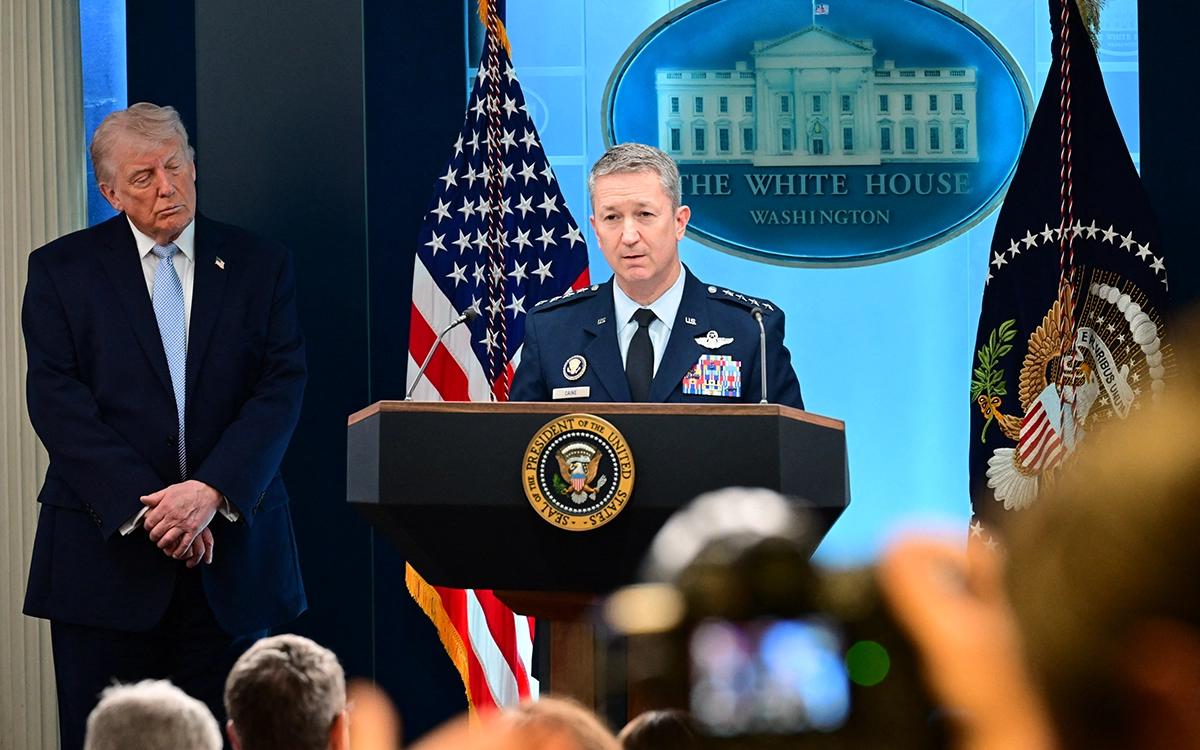
Gen. George’s replacement also raised some eyebrows. As vice chief of staff, Gen. Chris LaNeve assumed the role in an interim capacity. To be confirmed permanently, he must receive Senate approval, and other candidates remain under consideration. A highly decorated officer, Gen. LaNeve got on Trump’s radar when he made a political video while commanding the Eighth Army in Korea that congratulated the president on his election victory. In the 14 months since, Gen. LaNeve has moved rapidly through senior positions—serving as a top military aide to Hegseth, then vice chief, and now acting chief.
The strategic implications of Hegseth’s tenure at the Pentagon extend beyond the Army’s internal dynamics. A cloud of doubt hangs over America’s alliances, as partners grow uneasy about the political-military instability within a key security guarantor. When countries such as Japan or South Korea assess the reliability of U.S. defense commitments, they go beyond counting aircraft carriers to also assess the competence and stability of the institutions behind them.
Adversaries are watching closely as well. As Iran weighs American resolve during the two-week ceasefire or China calculates its next moves in the Pacific, both will scrutinize the disruption in military leadership in search of meaningful intelligence. They may interpret the purge as instability, weakness, or evidence of political dysfunction—none of which strengthens American deterrence.
The episode also raises longer-term questions. What kind of military does the United States want? Since World War II, it has maintained a professional, apolitical force that pledges to protect constitutional values and deliver candid advice to the Commander in Chief. That model now appears to be under strain by a military that seems to be selecting senior leadership based on its ideological alignment rather than professional experience.
The episode also raises longer-term questions. What kind of military does the United States want? Since World War II, it has maintained a professional, apolitical force that pledges to protect constitutional values and deliver candid advice to the Commander in Chief
When Truman fired MacArthur, Harold Ickes, a former Roosevelt official and later a columnist, warned that subordinating the president’s authority to a general’s would set a dangerous precedent—one that could “develop into a monstrosity—an uncontrollable military.” A principle, not a preference, guided Truman’s decision and preserved civilian control of the military. That same logic does not seem to prevail in Hegseth’s Pentagon.
The military has survived difficult political impasses before, thanks to a resilience embedded in a deep professional culture and long institutional memory. That culture is not indestructible, though. To sustain it, those who serve—from privates to generals—must believe that rank and promotion are earned through performance. Political leaders must value candid counsel over expedient agreement. With roughly 450,000 active-duty soldiers in the Army, thousands of whom are now deploying to a combat theater, the question of whether leaders are chosen for competence or for loyalty is not an abstract one.
It is the kind of question that, in war, is answered in blood.