
Eagle Intelligence Reports
The capture of Venezuelan leader Nicolás Maduro by U.S. special forces has altered Kim Jong Un’s strategic calculus by collapsing the distinction between wartime and peacetime threats to regime survival. For Pyongyang, the nuclear deterrent no longer functions as a bargaining chip, but rather as a core instrument of regime survival. This shift in threat perception elevates survivable second-strike capacity from an item of strategic leverage to an existential requirement, narrowing Pyongyang’s options.
The Maduro operation reinforces Kim’s long-standing narrative that a “hostile U.S. imperialism” is attempting to overthrow his regime. The image of a national leader adversarial to the United States being extracted from his palace and flown to New York to face trial is seen in Pyongyang not as a distant geopolitical event, but as a concrete illustration of the existential threat that Washington represents to any regime it deems unfavorable to its strategic interests.
Historically, the Kim dynasty has understood U.S.-led regime-change operations—from Milošević to Hussein and Gaddafi—as cautionary tales of what happens to adversarial states that lack a credible nuclear shield. The Venezuelan precedent, however, stands out because it comes amid U.S. President Donald Trump’s shift from transactional bilateralism to interventionism. Pyongyang condemned the operation, calling it an act of “high-handedness” and responding with tests of hypersonic missiles the next day. The response suggests that Kim has interpreted the Caracas strike as further evidence that regime survival depends on the irreversibility of North Korea’s nuclear state status.
Kim has interpreted the Caracas strike as further evidence that regime survival depends on the irreversibility of North Korea’s nuclear state status
The hypersonic missile test conducted within 24 hours of Maduro’s capture marks a transition in North Korean strategic signaling. While it is more likely that the tests targeted South Korean President Lee Jae-Myung’s visit to China scheduled for the same day, their coincidental timing has the side effect of issuing a kinetic rebuttal to the Caracas incident. According to the Korean Central News Agency, Kim personally oversaw the test, describing it as an “important technological task” necessary for the “recent geopolitical crisis.” In contrast to Maduro—whose regime relied on conventional defenses that proved vulnerable to U.S. special operations—Kim sends a message to Washington that any attempt to conduct a comparable operation in North Korea would face destructive consequences.
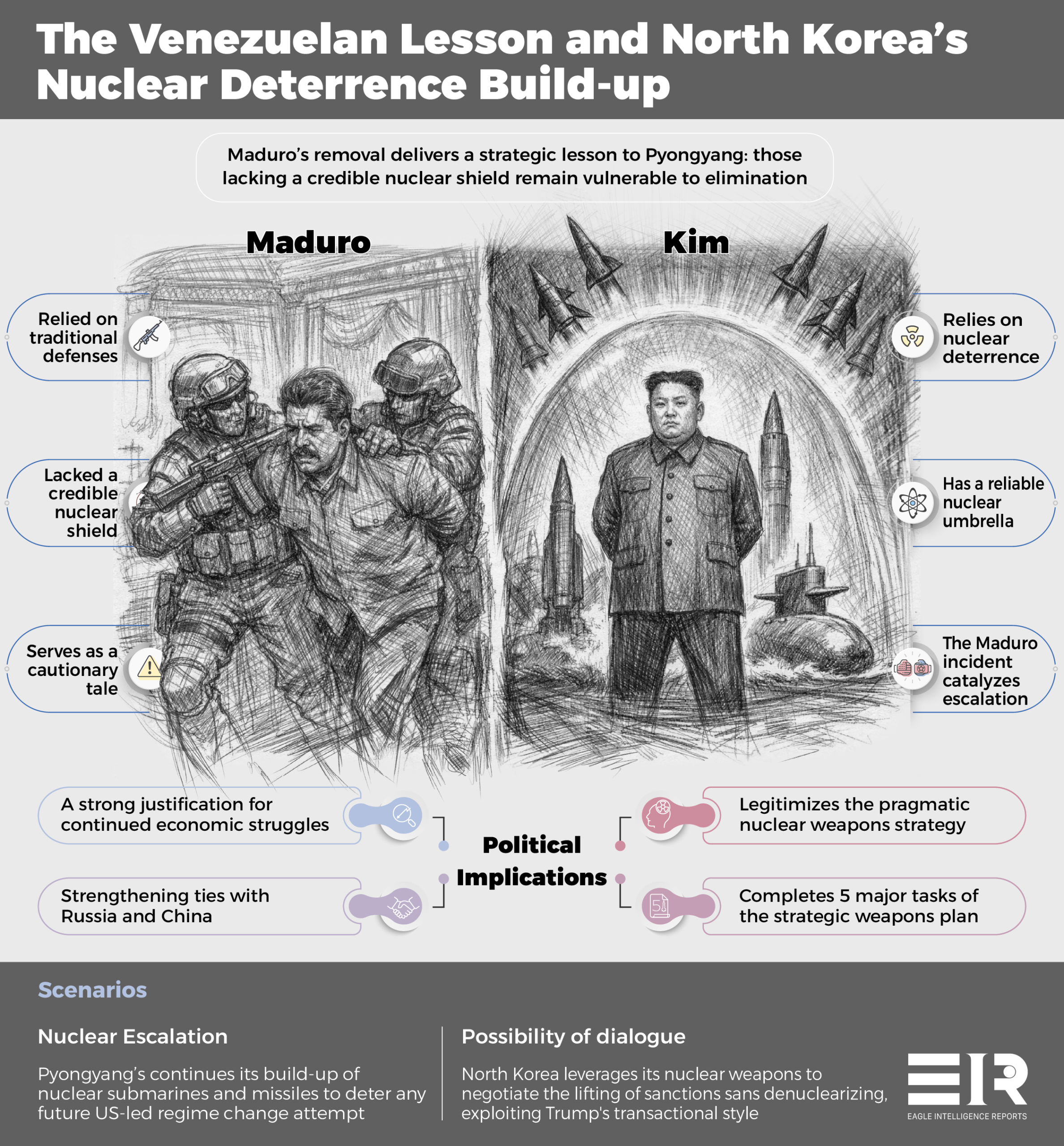
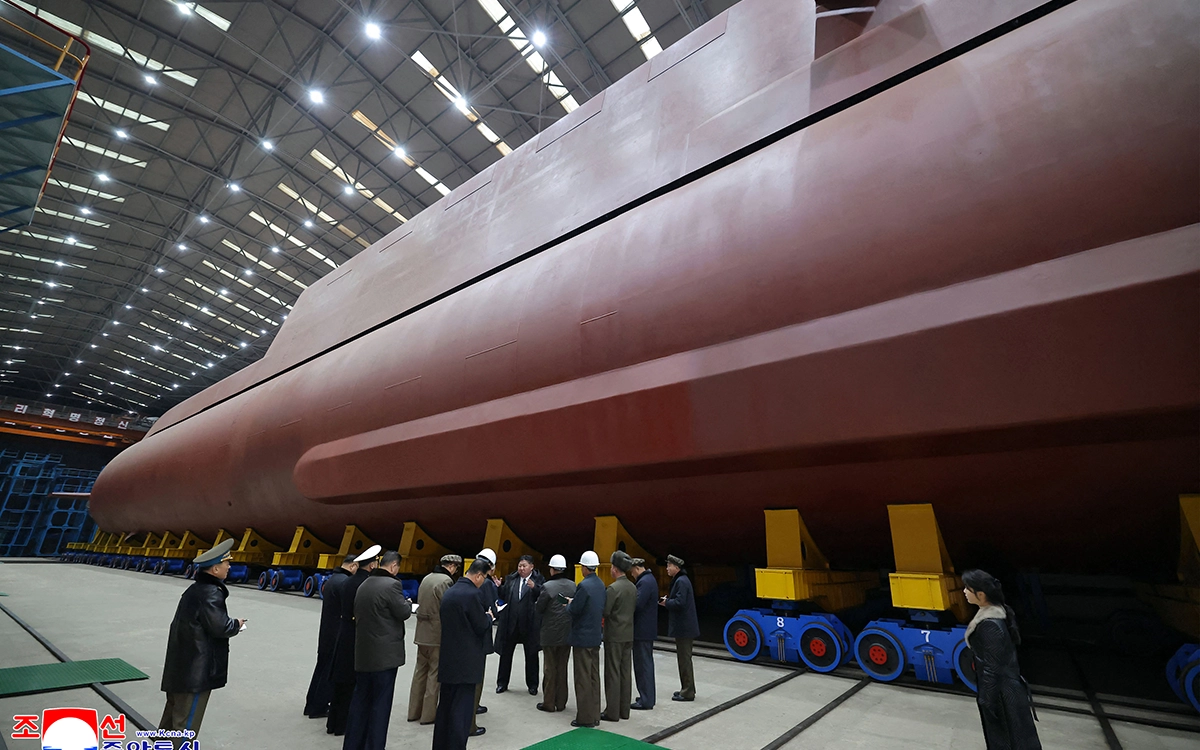
The missile tests form part of a pattern of North Korean advanced weapons signaling, including the October unveiling of solid-fueled Hwasong-20 missiles and the December disclosure of an 8,700-ton-class nuclear-powered guided-missile submarine. While doubts remain about the regime’s ability to operationalize the submarine, its unveiling demonstrates Pyongyang’s strategic intent to strengthen deterrence capabilities. The nuclear-powered submarine would have essentially unlimited range and significantly longer submergibility.
By transitioning from conventional submarines to a nuclear-propelled platform, Kim is pursuing a survivable second-strike capability. Such an undersea force is intended to negate the U.S. decapitation doctrine by ensuring that even if the command structure in Pyongyang were neutralized, a mobile, submerged nuclear deterrent would remain. For the ROK–U.S. alliance, this complicates maritime surveillance and preemptive planning. It introduces a mobile platform capable of launching long-range, nuclear-tipped cruise missiles from unpredictable locations, fundamentally challenging the alliance’s “Kill Chain” preemptive strike strategy.
The January 4 tests coincided with the start of Lee’s state visit to Beijing, effectively upstaging his diplomatic agenda and signaling that Seoul’s pragmatic diplomacy is irrelevant in the face of North Korean hard power. Kim seeks to push South Korea to decouple from China. By criticizing South Korea’s pursuit of nuclear-powered submarines—a project recently greenlit by the Trump administration—Kim frames Seoul as an aggressor whose actions justify Pyongyang’s own nuclear expansion. This mirror-imaging tactic aims to drive a wedge between Seoul and Washington by suggesting that South Korea’s pursuit of advanced naval technology is the primary driver of regional instability. It also highlights Pyongyang’s claim to capabilities Seoul has yet to acquire.
Kim’s mirror-imaging tactic suggests that South Korea’s pursuit of advanced naval technology is the primary driver of regional instability
Taken together, these developments narrow the political choices facing Pyongyang ahead of the Ninth Party Congress in early 2026. The Congress is expected to formalize a “Nuclear-Based Pragmatic Strategy” that moves beyond the rhetoric of self-reliance toward an institutionalization of permanent nuclear state status. In doing so, it would advance the completion of the “Five Major Tasks” of its strategic weapons plan outlined in the Eighth Party Congress in January 2021, including solid-fuel ICBMs, nuclear-powered submarines, and hypersonic missiles.
Domestically, the Maduro episode offers a powerful justification for continued economic hardship by reinforcing the regime’s narrative that nuclear weapons are not a bargaining tool, but the ultimate guarantor that North Korea will never share Venezuela’s fate. The Venezuelan operation also validates Kim’s 2022 Nuclear Force Policy Law, which authorizes preemptive nuclear strikes in the event of an imminent decapitation threat against the leadership.
The upcoming Party Congress will likely serve as the venue for Kim to institutionalize this new reality. The post-2022 rapprochement between Pyongyang and Moscow, following the Russian invasion of Ukraine, has facilitated greater access to advanced Russian weapons technology and eased constraints on North Korea’s deterrence development. As a result, doctrine emerging from the upcoming Congress is expected to move away from the language of “self-reliance” (Juche) and toward a more consolidated alignment in the “New Cold War” bloc, emphasizing ties with Russia and China.
The strategic landscape facing Pyongyang in 2026 bears little resemblance to the diplomatic theater of the 2019 Hanoi Summit. At that time, Kim arrived in Vietnam as the leader of a state reeling from heavy sanctions and international isolation. Today, he presents himself in diplomatic exchanges as the leader of a nuclear power, fortified by a comprehensive strategic partnership with Moscow and a stabilized relationship with Beijing. This newfound external support has fundamentally altered Kim’s leverage. He is no longer a supplicant seeking sanctions relief through compromise; instead, he now leverages Washington’s openness to dialogue to secure recognition of North Korea as a nuclear power and ultimately push the United States to abandon denuclearization of the peninsula as a policy objective.
For Pyongyang, the strategic reality in 2026 is one in which alignment with China and Russia provides it with a shield against U.S. pressure, even amid heightened concern over Maduro’s capture. China’s role in this dynamic remains particularly important, as it has recalibrated its relationship with Pyongyang while increasing cooperation with the Russian war machine in Ukraine. Moreover, the decapitation operation in Venezuela has further modified Beijing’s security calculus, reinforcing Kim’s position as a vital “buffer state” against U.S. power projection. Thus, increased pressure has been put on U.S. military presence across the First Island Chain amid Beijing’s grand strategy to retake Taiwan, by force if necessary, and secure its territorial interests in the South China Sea.
Whether Kim will pursue renewed dialogue with Trump remains uncertain. Heightened tensions and possible threats against regime security may push Kim to initiate dialogue with Washington to dissuade any U.S. military action against North Korea. However, deterrence theory suggests that, at least in the short term, a perceived vulnerability to physical threats often leads to an increase in the state’s military power.
Although Kim has said that he personally has “good memories” from his 2018–2019 meetings with Trump, he has positioned recognition of North Korea as a nuclear state as a prerequisite for any dialogue. Absent such a shift, Pyongyang’s position is unlikely to change before Trump’s scheduled visit to China in April, which is when the opportunity for dialogue may open, according to South Korea’s National Intelligence Service.
Kim has positioned recognition of North Korea as a nuclear state as a prerequisite for any dialogue with the US
Over the longer term, Kim’s regime faces two distinct paths, each carrying profound implications for regional power dynamics. In a first scenario, Kim chooses to maximize his leverage by conducting a seventh nuclear test or a full-range ICBM flight over Japan to demonstrate the futility of U.S. decapitation plans, while also completing Pyongyang’s development goals for advanced weapons systems.
This strategy of escalatory defiance is designed to achieve asymmetric parity in which nuclear-powered submarines and solid-fuel ICBMs allow Kim to establish a credible “second-strike” capability that prevents any U.S. attempt at regime change. Such a strike, potentially against the American mainland, would be an unacceptable cost for Washington. For Kim, this is the only strategic option that guarantees sovereignty in an era where conventional defenses can no longer deter U.S. intervention.
The costs associated with this escalation path are primarily structural and economic. Sustained investment in the “Five-Year Plan for National Defense” has pushed North Korea toward a war-economy posture that prioritizes military-industrial output over civilian consumption. The diversion of rare materials and high-tech components to the hypersonic and submarine programs has effectively undermined the broader North Korean economy. Kim’s strategic calculus, however, mitigates these domestic costs by deepening alignment with Moscow and Beijing. Through these ties, Pyongyang has secured a sanctions-proof lifeline of energy and food that allows the regime to sustain its nuclear build-up despite total Western isolation.
Kim’s decision-making is characterized by a high risk tolerance rooted in a perception of the international order as a raw contest of power. To him, the post-Cold war era of U.S. restraint has ended, giving way to a “neo-Cold War” in which only nuclear-armed states are untouchable. His calculus for the Ninth Party Congress is to institutionalize this assessment by embedding the “hostile two-state” policy into party bylaws, formally defining South Korea as a separate adversarial entity. This signals that regime survival is no longer framed in terms of reunification or dialogue, but rather the permanence of its nuclear shield. Strength, in this view, lies not in diplomacy but rather the capacity for catastrophic retaliation.
The deterrence environment on the Korean Peninsula is therefore evolving from strategic deterrence to intra-war deterrence focused on managing escalation. Kim’s principal vulnerability, however, lies in intelligence asymmetry. Moreover, the Caracas operation succeeded due to precise, real-time tracking—a point of vulnerability that Kim has attempted to address by reshuffling his personal security guard and replacing top intelligence officials in early 2026.
In this context, Seoul’s preference for engagement could give way to a more assertive strategic posture that accelerates the modernization of the ROK–U.S. alliance, including the development of South Korea’s own nuclear-powered submarines and possible nuclear weapons development. This shift would force the ROK–U.S. alliance to confront the reality that existing missile defense systems like THAAD and Patriot are ineffective against irregular hypersonic trajectories. China, conversely, would view this scenario with mounting alarm. While Beijing has rolled back its opposition to North Korean nuclearization in order to counter U.S. influence, a North Korean breakout risks a destabilizing nuclear arms race in Northeast Asia—an outcome Beijing desperately wants to avoid.
A North Korean breakout risks a destabilizing nuclear arms race in Northeast Asia—an outcome Beijing desperately wants to avoid
In a second scenario—the tactical pivot—Kim uses the Ninth Party Congress to offer a “freeze for relief” deal, leveraging his new nuclear status to demand the removal of sanctions without full denuclearization. This move would aim to shift negotiations to arms control, exploiting Trump’s transactional style. South Korea’s Lee would likely welcome this as an opening for his long-awaited engagement with Pyongyang. Such a possibility has a precedent. In 2018, Kim pursued dialogue with Seoul and Washington in the wake of intensified sanctions, accelerated nuclear testing, and heightened confrontation with the Trump administration.
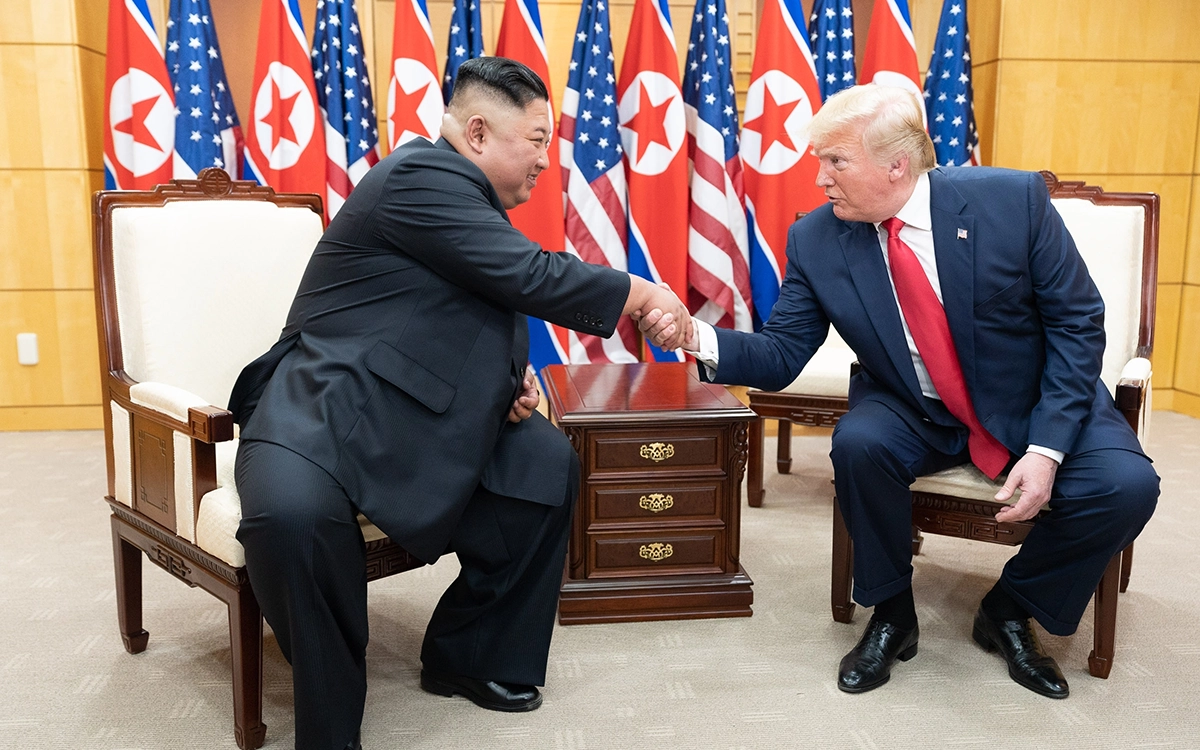
Strategically, this option allows Kim to transition from a pariah state to a de facto nuclear power while addressing structural economic bottlenecks. By offering a moratorium on ICBM flight testing or a verifiable cap on fissile material production at Yongbyon, Kim seeks to shift the diplomatic goalposts from denuclearization to arms control. This approach underpins a nuclear-based pragmatic strategy in which advanced weapons remain central to deterrence while limited relief secures the energy and materials needed to sustain the new economic and military vision of the Ninth Party Congress.
The costs associated with this tactical pivot are primarily ideological and geopolitical. Internally, Kim must manage the potential dilution of the “hostile two-state” narrative that has justified extreme militarization and the sacrifice of civilian welfare. Externally, he risks alienating Moscow, which currently values North Korea as an unrestrained military partner.
For Pyongyang, the 2025 U.S. National Security Strategy’s complete omission of North Korea further underscores a shift in the deterrence environment. By contrast, Trump’s 2017 NSS mentioned Pyongyang 16 times, calling it a destabilizing threat. This move suggests that Washington now views North Korea as a secondary priority, situated behind the overarching “America First” focus on economic competition with China and the reestablishment of dominance in the Western Hemisphere.
Nevertheless, domestic political considerations may still sustain the prospect of engagement. With the November 2026 midterm elections approaching and approval ratings declining, Trump retains the option of renewed dialogue with North Korea as a card to play in a potential “October surprise,” to appeal to American voters. Even limited and symbolic talks with Kim could be framed as a major foreign policy victory, particularly given the previous administration’s failed attempts. From Kim’s perspective, a freeze deal may offer Trump a low-cost political victory, effectively trading a pause in nuclear development for the international recognition North Korea was denied at the 2019 Hanoi Summit. Therefore, despite the NSS’s strategic omission, the political value of a potential summit makes North Korea a persistent foreign policy tool for the Trump administration.
However, Seoul may fear a “Hanoi 2.0” security sell-out, which could provoke an accelerated independent defense build-up. China, on the other hand, would likely tacitly approve the de-escalation, aiming to stall further U.S. strategic deployments in Northeast Asia.
China would likely tacitly approve the de-escalation, aiming to stall further U.S. strategic deployments in Northeast Asia
In the wake of Maduro’s capture, Pyongyang has hardened its posture, potentially accelerating fractures in the regional order. The shift threatens to consolidate the transactional alignment between North Korea, China, and Russia while reinforcing a more militarized trilateral coordination between South Korea, the United States, and Japan. Stability under this configuration would rest on a precarious “balance of terror” rather than durable accommodation. As North Korea advances undersea and long-range strike capabilities, confidence in deterrence could drop, and Seoul and Tokyo may seek a trilateral nuclear-sharing agreement with the United States to replace or complement the pre-existing deterrence framework in the region.
North Korea’s response to Maduro’s capture removes any remaining ambiguity about Pyongyang’s strategic posture. In Kim’s understanding of the post-Cold War order, weakness and conventional defense invite intervention while nuclear deterrence permanently forecloses it. The Caracas operation, in this view, is proof of concept.