
Eagle Intelligence Reports
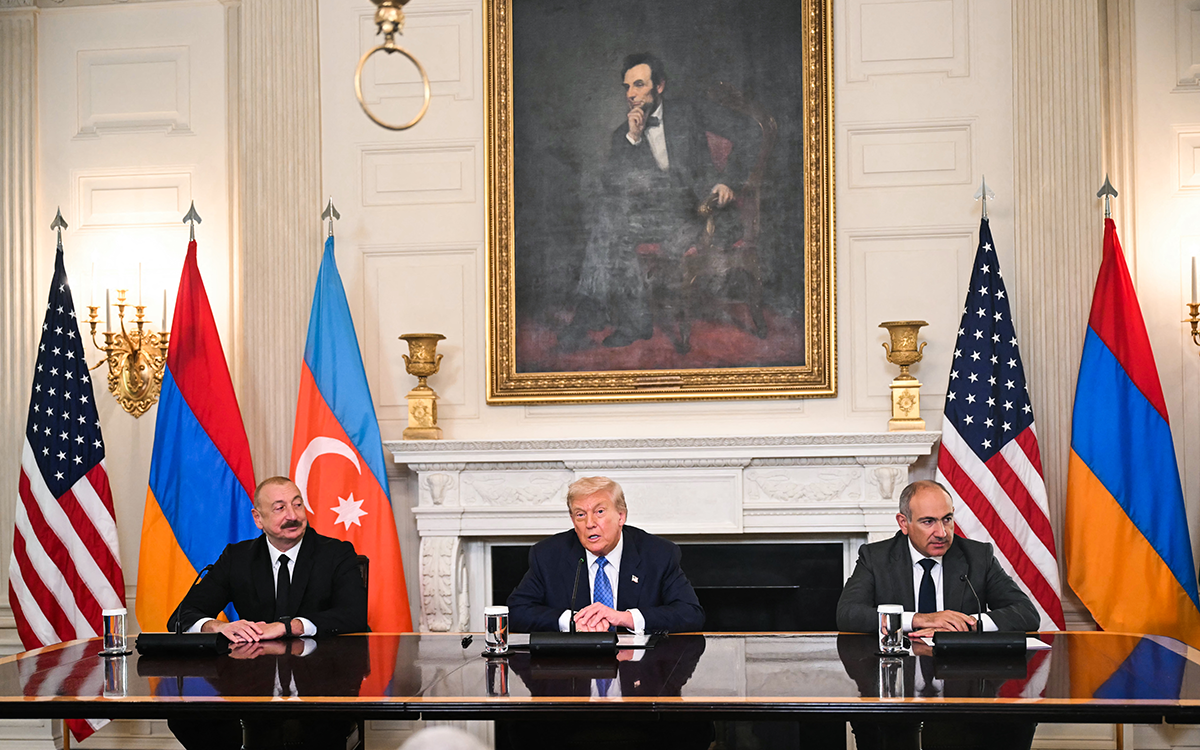
The Trump administration has unveiled an ambitious plan to bring peace, prosperity, and renewed US influence to the South Caucasus. Russia’s declining sway in the region, combined with the absence of strong regional structures, has created a strategic vacuum that external powers are eager to fill. Seizing the moment, Washington moved quickly to leverage Azerbaijan’s recent military victories over Armenia, urging both sides to set aside historic grievances and pursue economic and security gains through expanded regional connectivity.
If the United States succeeds in establishing a firmer geopolitical foothold in the South Caucasus, Washington will more effectively contain Russia, constrain Iran, and compete with China. However, this bold vision and an unprecedented US commitment hinge on Armenian-Azerbaijani reconciliation, which remains tenuous and troubled. Additionally, the US strategy toward Georgia remains surprisingly undefined. Further, competing powers have diverging ambitions for this strategic crossroads and, given the complexities, one must prepare for diverse future scenarios.
If the United States succeeds in establishing a firmer geopolitical foothold in the South Caucasus, Washington will more effectively contain Russia, constrain Iran, and compete with China
US leaders believe that Armenia and Azerbaijan can achieve considerable commercial gains by expanding their connections with each other and the resource-rich regions of Central Asia and the Caspian Basin. By eliminating barriers and constructing new infrastructure, the South Caucasus will become a better conduit for delivering Eurasian energy, minerals, and other goods to Europe. This economic interdependence will promote peace, since the White House calculates that people will eschew actions that jeopardize their prosperity. In a virtuous circle, the resulting increased stability in the region will attract more foreign investment and develop resilience against external threats.
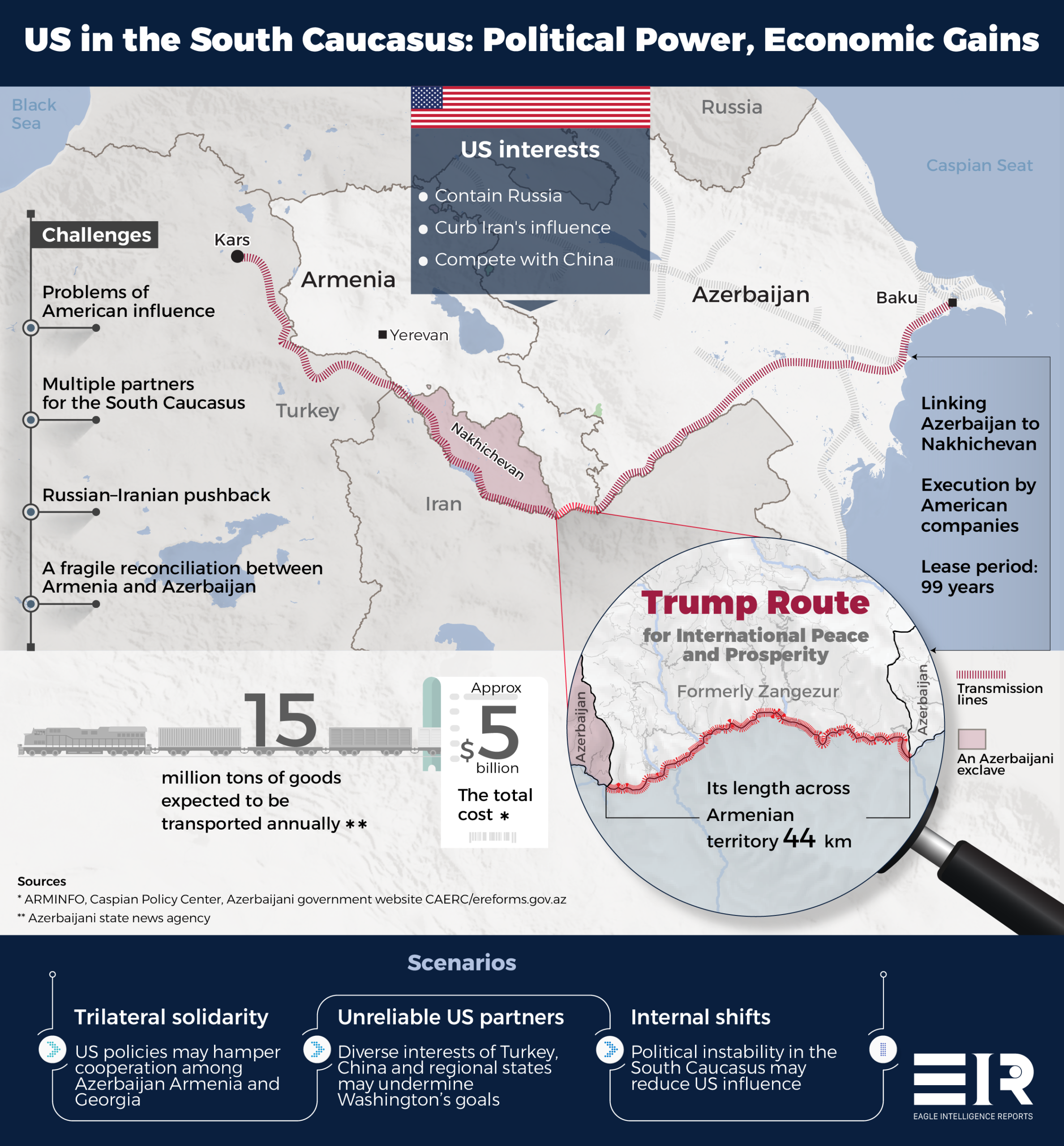
On August 8, 2025, US President Donald Trump, Armenian Prime Minister Nikol Pashinyan, and Azerbaijani President Ilham Aliyev signed a declaration to normalize relations with a peace treaty. The Trump Route for International Peace and Prosperity (TRIPP) is the foundation of the US peace plan. This conduit, which Baku and its partners termed the “Zangezur Corridor,” will connect Azerbaijan’s Nakhichevan exclave, in southern Armenia near Iran, with the rest of Azerbaijan. The peace process could also provide Armenia with expanded access to Central Asia and the Caspian Basin by opening its long-closed borders with Azerbaijan and Turkey.
Though Armenia will retain sovereignty over the area, US entities will construct the TRIPP. They will enjoy exclusive development rights and a 99-year lease of the 44 km route along the Armenian-Iranian border. In addition to reconciling Armenian and Azerbaijani demands, the new mechanism gives the United States leverage over trans-Eurasian transit. Nonetheless, the administration is open to other parties financing the cables, pipelines, railways, and roads needed to expand the Trans-Caspian International Transport Route (aka “the Middle Corridor”). Washington prefers this East-West artery since it circumvents Russian, Iranian, or other territory under US sanctions.
Several developments have created a more benign environment for greater US influence in the South Caucasus
Several developments have created a more benign environment for greater US influence in the South Caucasus.
Previously, Moscow manipulated tensions between Armenia and Azerbaijan to constrain their foreign policies. But in 2020 and 2023, the Russian government, alienated from the new Western-friendly government in Yerevan cultivating ties with Baku and Ankara, stood aside and allowed Azerbaijan to defeat Armenia and recover the disputed territory of Nagorno-Karabakh.
Armenians no longer trust Moscow to defend their interests and have, de facto, acknowledged that they cannot recover Nagorno-Karabakh now since its ethnic Armenians have fled. In response, Yerevan has suspended its participation in the Moscow-led Collective Security Treaty Organization, strengthened ties with alternative powers like China and the United States, and strived to normalize relations with Azerbaijan, Pakistan, and Turkey. In June, Pashinyan became the first Armenian head of government to visit Ankara in decades.
Meanwhile, the victorious Azerbaijani government has become more confident in confronting Moscow. After Russia downed an Azerbaijan Airlines plane over Chechnya in December 2024, Baku compelled Russian President Vladimir Putin to apologize for the incident and pay compensation. When Russian authorities in Yekaterinburg later arrested members of an alleged ethnic Azeri gang, leading to the death of a pair of brothers, Azerbaijan opened a criminal case against Russian law enforcement officers and cancelled several Russian-related events and visits. Their reciprocal media attacks eased only after Aliyev met Putin several months later.
The US plan benefits from the growing ties between the South Caucasus and Central Asia. The Caspian littoral countries are spending generously on trans-regional infrastructure, including railways, airways, ferries, energy pipelines, and, recently, fiber-optic cables. Beijing’s Belt and Road Initiative, regional banks, and other external drivers are augmenting these efforts.
Reflecting these trends, in November 2025, the 7th Consultative Meeting of the Heads of State of Central Asia formally admitted Azerbaijan as its sixth member, complementing their existing ties through the Commonwealth of Independent States and the Organization of Turkic States.
Though recent events have boosted US influence in the South Caucasus, the American grand vision faces substantial obstacles.
The political and security instruments of power that the United States can apply to the South Caucasus are limited. US plans rely heavily on personal diplomacy, led by President Trump and other senior US leaders, to sustain the Armenian-Azerbaijani peace process. However, as Trump’s team is engaged in a dozen regional peace processes, the South Caucasus could lose its attention. US leadership engagement in the South Caucasus has been fickle. The next US president may have different priorities. Though émigré groups, congressional coalitions, and commercial interests in the United States are attentive to the region, their priorities diverge from each other and those of the Trump administration.
The United States often employs security cooperation to influence other governments. But in the South Caucasus, Russia is the preeminent security partner of both Armenia and Azerbaijan. Further, Armenia is buying various ground systems and advanced fighter planes from India, while Azerbaijan has supplemented longstanding defense imports from Israel and Turkey with purchases of warplanes from India and air defenses from China.
The United States often employs security cooperation to influence other governments. But in the South Caucasus, Russia is the preeminent security partner of both Armenia and Azerbaijan
Similarly, past US efforts to sanction Azerbaijan and Georgia to influence their policy choices proved ineffective because they prioritized autonomy over their modest commercial ties with the United States. US companies will not make significant, sustained investments in the South Caucasus until the regulatory environment, regional security, and anticipated profits improve. Even with a better business climate, Chinese and EU capital will almost certainly exceed US financing by several orders of magnitude.
These factors partly explain why no South Caucasus government accords primacy to its US ties. Armenia, Azerbaijan, and Georgia now all practice some form of multi-vector diplomacy. None of these countries will soon become a US ally. Azerbaijanis want to develop the North-South Transport Corridor, which traverses Russia, Iran, and India, concurrently with East-West arteries. Armenia’s reconciliation with Azerbaijan and Turkey will remain tenuous until Armenians approve a referendum next year on proposed constitutional changes renouncing territorial claims.
US policy toward Georgia, which lies athwart the Middle Corridor, remains undeveloped. The country’s ports, pipelines, and other infrastructure connect Central Asia, the Caspian, and the rest of the South Caucasus with the Black Sea, Southern Europe, and the Eastern Mediterranean. Georgia is also one of the few former Soviet republics that is moving closer toward Russia, despite Moscow’s occupation of a fifth of its internationally recognized territory.
Though weakened, Russia retains substantial instruments of leverage and coercion. Hundreds of thousands of South Caucasus citizens work in Russia, sending sizeable remittances home. Many local political, media, and business leaders have strong Russian connections. Though only Armenia belongs to the Moscow-led Eurasian Economic Union, all three countries rely heavily on Russian trade, energy, and investment. Citing various pretexts, Gazprom has suspended gas deliveries to Armenia several times this year.
The Kremlin will leverage these economic tools to constrain US commercial activities in the South Caucasus. Kremlin-friendly Russian sources will continue disseminating anti-US messages in the region’s print, broadcast, and social media.
Moscow can also employ more direct forms of coercion. The Russian military retains facilities in Armenia, while Russian border guards still patrol some of Armenia’s frontiers. Moscow is constructing a Black Sea military base in occupied Georgian territory. Though free of Russian troops, most of Azerbaijan’s weaponry still comes from Russia. If the Russian-Ukraine war becomes less intense, Moscow will have even more military assets available to coerce regional governments.
The South Caucasus constitutes Iran’s northern frontier. Azerbaijan’s relations with Iran are traditionally tense due to its government’s close ties with Israel and the large ethnic Azeri majority in northern Iran. Having recently suffered political-military setbacks throughout the Middle East, Iranian leaders are especially sensitive to the proposed US presence along Iran’s northern border, which could disrupt Iran’s ties with Armenia, Azerbaijan (especially Nakhichevan), and other states. Though Iran lacks unilateral means to resist the expanding US role in the South Caucasus, Tehran can partner with Moscow to amplify Russian influence, especially in Armenia and Georgia.
Though Iran lacks unilateral means to resist the expanding US role in the South Caucasus, Tehran can partner with Moscow to amplify Russian influence, especially in Armenia and Georgia
Several developments could decisively tip this balance of opportunities and challenges.
US actions are giving the South Caucasus an opportunity to cooperate for mutual gain. Small and disconnected, Armenia, Azerbaijan, and Georgia have traditionally been objects of rivalry between various iterations of the Persian, Ottoman, and Russian empires. In the past, these three countries exhibited little foreign policy coordination. Now, they have adopted the same multi-vector approach toward alignments.
If Armenia and Azerbaijan could manage their differences, they could cooperate more with Georgia. Not only would this increase their socioeconomic connectivity, but enhanced collaboration would also elevate their collective autonomy and leverage vis-à-vis third parties.
However, US policies could amplify power imbalances among Armenia, Azerbaijan, and Georgia. Rewarding Azerbaijan could decrease Baku’s incentives to make the necessary concessions to reconcile Armenians to their new situation. Ignoring Georgia could accelerate a Moscow-Tbilisi rapprochement that will complicate US plans for the South Caucasus.
Whether China and Turkey cooperate or conflict with US goals in the South Caucasus will substantially impact their realization.
Most of the trade and investment flowing into the Eurasian countries south of Russia now emanates from China. The PRC has signed strategic partnerships with Armenia, Azerbaijan, and Georgia in recent years. The United States and China share short-term commercial interests in expanding East-West transit through the South Caucasus. However, their capacity to compartmentalize islands of cooperation amidst their numerous conflicts is questionable. Beijing’s long-term ambition is to envelop the South Caucasus within its Eurasian sphere of influence.
Turkey’s size and proximity give it considerable economic and security heft in the South Caucasus. Relations between Azerbaijan and Turkey have been especially close due to deep ethnic, cultural, and religious ties. Moscow underestimated the potential of the Turkey-Azerbaijan alliance to break the box the Kremlin had constructed in the South Caucasus. Turkey has also become one of Georgia’s most important diplomatic and economic partners.
Turkey is the most influential formal US ally in the South Caucasus. Turkey hosts a sizable US military presence and cooperates with Washington regarding several European and Middle Eastern hotspots. But Ankara often pursues its own path on Eurasian issues, especially with Russia. Turkey may decline to follow Washington’s plans to open its borders with Armenia, limiting regional gains from trade.
Turkey may decline to follow Washington’s plans to open its borders with Armenia, limiting regional gains from trade
Though all three South Caucasus governments have adopted measures to neuter their domestic opposition and limit foreign interference in their internal politics, Georgia and Armenia have a striking post-Soviet record of political instability.
Should Georgia’s democratic opposition replace the country’s Kremlin-oriented government, the United States could integrate Georgia more comprehensively into its regional strategy. Conversely, should next summer’s Armenian elections bring an ultra-nationalist or pro-Russian government to power, or should Armenian voters reject the proposed changes to their constitution demanded by Baku and Ankara, Washington could lose its preeminent mediating role between Baku and Yerevan.
The US aspiration to reshape the international relations of the South Caucasus is understandable, given the geoeconomic importance of the South Caucasus, which is situated between Europe, Asia, and the Middle East, all priority regions for US foreign policy. But Washington must overcome several obstacles to realize its regional ambitions.